
You do not find out whether a landing net is any good in the store. You find out in the second season, after the hinge has been folded and unfolded a few hundred times, after the mesh has dried stiff in the sun a few dozen times, and after you have dropped the frame on wet basalt at least once because both hands were full of rod and tippet. Everything looks fine in the first month. That is the whole problem with first month reviews.
I have carried the PLUSINNO folding net long enough to have opinions that do not match the ones at the top of the review page. It is a good net. It is not a perfect net, and the space between those two sentences is what this review is about. If you want the short answer, the verdict block below will do it. If you want to know what you are actually buying before you spend anything, keep reading.
I spent most of my working life as an aircraft maintenance technician, and the habit that stuck is this: judge a part by how it fails, not by how it looks when it is new. A landing net fails in three places. The hinge, the seam where the mesh wraps the frame, and the connection to your vest. That is where I looked, and that is what I am going to tell you about.
The Quick Verdict
A light, honest trout net that disappears on your back. The fold costs you some rigidity and a little maintenance, and the hoop is smaller than the product title implies.
Amazon Check Today's Price →The net that lives on my vest instead of in the truck
17 inches collapsed, under a pound, with a rubber bag that shakes clean. If you walk to your fish rather than ride to them, this is the one I would hand you.
Amazon Check Today's Price on Amazon →The Numbers, and What They Actually Mean
The listing gives you real numbers and they are honest numbers. Hoop is 16 inches by 13 inches. Bag depth is 10 inches. Collapsed length is 17 inches. Extended length is 28 inches. Weight is 0.95 of a pound, or 15.52 ounces on the spec sheet. Frame is aluminum alloy, mesh is rubber, handle is composite.
What the listing does not do is translate any of that into a day on the water. A 16 by 13 hoop is the small end of what most trout anglers carry. It is a trout net, full stop. On the Crooked, where most of what you land runs between ten and sixteen inches, it is exactly right and a bigger hoop would just be dead weight swinging off your shoulder. On big water where a twenty inch fish is a live possibility, you will feel that rim.
The 10 inch bag depth is the number I care about most and the number almost nobody mentions. A deep bag holds a fish in the water while you back the hook out. A shallow bag lets a fish flip over the rim and back into the river, and it happens faster than you would believe until you have watched it. Ten inches holds a trout still without the fish touching the frame, which is the entire point of a rubber bag. It is not deep enough to swallow a big fish comfortably.
One more number worth noting. At 0.95 of a pound, this net does not drag on a vest strap all day. I have carried heavier sandwiches up the Metolius.
The Fold Is the Feature and the Fold Is the Cost
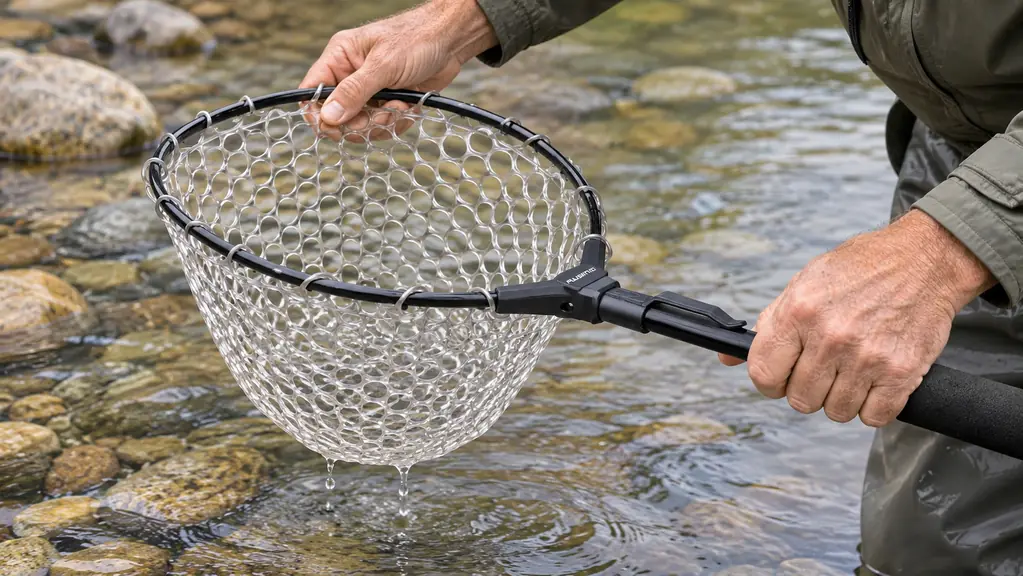
Every folding net on the market trades rigidity for portability, and the PLUSINNO is no exception. When it is open and seated, it feels solid in the hand. The joint is not sloppy. But a fixed frame net will always feel more direct on the scoop, because there is nothing between your hand and the hoop. With a folder there is a hinge, and you feel it, especially on a fish that decides to go under the boat at the last second.
When the joint is properly seated you can feel it, and that is worth learning. There is a small resistance and then a stop, and if you have not felt the stop, you have not seated it. A half seated joint is where a folder feels worst, and it is not the net's fault. It is the operator moving fast and not listening to his hands.
Where the folder earns its keep is the walk in. Long stretches of the Deschutes require covering two miles of bank before you find a fish, and a full sized net hanging off your back for two miles gets old by about mile one. At 17 inches collapsed and under a pound, this one clips to the back of a vest and disappears. I have forgotten I was wearing it, which is the best thing you can say about gear you only need four times a day.
The cost is that you have to open it. Every time. With cold hands, in low light, with a fish running. That is the honest price of a folder and it deserves to be said plainly, because the reviews that skip it were written by people who never fumbled one open while a good fish headed downstream.
In practice the motion becomes automatic after a dozen fish. Grab the hoop, snap it out, seat the joint, scoop. I do it without looking down now. But the first few times, with a fish on and your heart going, you will be slow, and the fish will not be.
The Rubber Mesh Is the Real Reason to Buy This
If you are still landing fish in a knotted nylon bag, the rubber alone justifies the switch. Knots abrade a fish. They strip the slime coat. They snag flies and hold them. The mesh on this net is smooth, wide open, and does none of that. A fish lies still in it instead of thrashing against a hundred little knots, and it goes back into the river in better shape.
It also does not tangle, which sounds minor until you have spent five minutes working a dropper out of a nylon bag while a fish sits half in the water waiting for you to get organized. The bag on this one shakes clean. The fish rolls, the mesh flexes, and the hook comes free.
The material on the PLUSINNO is listed as rubber over a nylon shell, and that combination is why it has held up. After a couple of seasons the seams are still intact. No splitting at the rim, no stretched openings, no sag in the bottom of the bag. The spot these bags fail is where the mesh wraps the frame, and this one has held there. I check that seam every spring the way I used to check a fuel line clamp, and it has given me no reason to look twice.
One honest note on rubber in general. It is heavier in the water than nylon when you are moving it, and it does not drain quite as fast. I do not notice it on a trout net this size. On a much bigger hoop I would, and that is a thing to keep in mind if you are comparing this against a large framed boat net.
The Handle, Which Nobody Bothers to Review
The handle is composite, not cork and not foam, and it is the part of this net I expected to dislike. Composite gets slick when it is wet and cold, and a slick handle on a landing net is a genuine problem, because the net is the one thing you grab at speed. In practice it has been fine. There is enough texture in the grip and enough shape to it that my hand does not slide, even with wet hands in November.
What I do not love is how little of that 28 inches ends up in your hand. The hoop and the joint take their share, and what is left is short. If you fish from a high bank with a fish holding three feet out, you will be leaning. This is a wading net, not a bank net, and it is better to know that now.
The composite does have one advantage over cork. It does not chip, it does not need sealing, and it does not get that chewed look cork develops after a few seasons in a hot truck cab. For a net that lives in a rig rather than a garage, that matters more than the feel.
The Magnetic Release, and the Parts That Are Just Okay
The net ships with a magnetic release and a carabiner, and this is the detail I did not expect to care about. The magnet lets you pull the net free with one hand and let it hang, then catches it again when you reach back. If you have ever tried to work a net off a D ring while a fish is thrashing at your feet, you know exactly why that matters.
The magnet is strong enough to hold through brush and weak enough to pull free without looking down. It has not let go on its own in the truck bed or on a steep bank, which was the failure I was watching for.
The carabiner is an ordinary gate, not a locking one. That is fine for a vest loop or a pack strap. It is not what I would hang a net from while scrambling down a rock chute. Clip it to something that is not going to see load and it will do its job for years.
What I Liked
- Folds to 17 inches and weighs under a pound, so it carries on a vest without you noticing it
- Rubber mesh is gentle on fish, shakes clean, and has held at the frame seam through multiple seasons
- Magnetic release makes one-handed stowing and grabbing genuinely easy
- Aluminum alloy frame feels solid once the joint is seated
- Hoop and 10 inch bag depth suit trout in the ten to sixteen inch range perfectly
Where It Falls Short
- 28 inches extended is short reach, and less of it is handle than you might expect
- 16 by 13 hoop is small for bass, steelhead or anything over twenty inches
- Hinge collects grit and gets stiff without an occasional rinse
- You have to open it every time, including with cold hands and a fish running
- Listed for bass, but it is really a trout net that will tolerate a bass
Where It Falls Short
Three things, and none of them are deal breakers, but you should hear them before you buy rather than after.
First, the reach. The net goes from 17 inches to 28 inches and 28 inches is short. If you wade deep or fish from a high bank, you will want more. It is enough to land a fish you have already played to the net beside you. It is not enough to reach a fish you have not quite finished. Plan on finishing the fight.
Second, the hoop is smaller than the listing implies. The word bass appears in the product title. You can land a bass in a 16 by 13 hoop. You will not enjoy landing a four pound bass in a 16 by 13 hoop, and neither will the bass. This is a trout net that will tolerate a bass, not the other way around.
Third, the hinge collects grit. Sand, silt, the fine volcanic dust we have in central Oregon, all of it works into the joint. Mine has not seized. It did get noticeably stiffer in its second season, and I now rinse it out after a dusty trip. That is maintenance I do not have to do on a solid frame net, and it is the one thing I would change if I ran the company.
A 16 by 13 hoop with a 10 inch bag is a trout net. You can land a bass in it. You will not enjoy it, and neither will the bass.
Storage, Off Season, and the Small Stuff
It folds to 17 inches, which means it fits behind the seat of the truck instead of rattling around in the bed. That sounds trivial until you have listened to a landing net bang against a wheel well for forty miles of washboard road. Mine rides in the cab between trips and it has come through August heat without warping.
The bag does hold water, which is worth knowing. A wet rubber bag folded against a vinyl seat will stay damp for a day and start to smell. Fold it open side out and it dries on the drive home. Small habit, saves you a nuisance.
Rinse the hinge at the end of a dusty trip and let the whole thing dry open. That is the entire maintenance routine. I do it in the driveway with a hose, thirty seconds, and put it away. Two seasons of that and the joint still seats cleanly.
Who This Is For
Trout anglers who walk. If your fishing involves covering ground, this is the net. It clips on, it stays out of the way, and 16 by 13 with a 10 inch rubber bag handles anything you are likely to hook on the Deschutes or the Crooked.
Catch and release anglers. The rubber bag and the knotless mesh are gentler on a fish than anything nylon, and if you care about release survival, switching to rubber is the single easiest improvement you can make to your setup. The difference in how a fish goes back is not subtle.
Anglers who are hard on gear. The PLUSINNO has an aluminum alloy frame and a rubber bag, and losing the whole thing off a pack strap would be annoying rather than a disaster. That is a real quality in equipment that rides on the outside of your vest, and I am that kind of angler.
Who Should Skip It
If you fish from a boat with room for a full sized net, buy a full sized net. A fixed frame with a longer handle is more direct in the hand and asks less of you. The folder is a compromise you make for the walk. If you are not walking, you are carrying a feature you never use.
If you chase big fish, skip it. A four pound bass, a steelhead, a pike, any of them will make a 16 inch hoop feel like a coffee cup. Get a bigger hoop and a deeper bag. This net is not built for that, and it is not honest to pretend otherwise.
And if you cannot stand a hinge that wants a rinse now and then, skip it too. It is not a lot to ask. It is more than zero, and you should decide that for yourself before you buy.
If you walk to your fish, this is the net I would hand you
17 inches collapsed, under a pound, rubber bag, magnetic release. Know going in that the hoop is a trout hoop and the reach is a wading reach. Then it does its job without complaint.
Amazon Check Today's Price on Amazon →