

Two nets, one decision. That is what this comes down to when you are standing in a fly shop with a vest that already weighs more than you would like. The PLUSINNO Fly Fishing Net is the one that folds, stows, and disappears until the moment you need it. The Frabill Floating Trout Net is the one that never folds, never stows, and never sinks. I have carried both styles on the Deschutes and the Crooked, and the choice between them is less about which company builds a better net than about which failure you can live with.
Here is the short answer. If you walk in, fish small to medium water, or want a net that clips to your vest and stays out of your way, buy the PLUSINNO. The hoop measures 16 by 13 inches, the bag is 10 inches deep, and it collapses from 28 inches to 17 so it rides flat against your back. If you wade deep water and you have ever watched a net go downstream without you, buy the Frabill. Everything past that is detail, and I will walk the details below, including the ones that argue against the net I would personally buy.
| PLUSINNO Fly Fishing Net | Frabill Floating Trout Net | |
|---|---|---|
| Hoop and bag | 16 by 13 inch drop hoop with a 10 inch deep bag | Compact teardrop bow sized around trout |
| Reach | Extends to 28 inches, so you stay out of the current | Fixed short handle, you lean further to scoop |
| Packing | Collapses to 17 inches, clips flat to a vest or pack | Rides on a lanyard, always open |
| If you drop it | Aluminum alloy frame, it sinks | Floats by design, that is the whole point of it |
| Mesh | Rubber mesh, does not tangle, easy on fish | Knotless bag, gentle but it grabs hooks |
| Ready when a fish takes | You unfold it before you scoop | Always open, nothing to unfold |
| Wear points | Hinge and slider need rinsing and drying | One-piece frame, very little to fail |
| Weight | 0.95 lb, or 15.52 ounces on the spec sheet | Light in the hand on a short handle |
| Best water | Creeks, small to medium rivers, high lakes, bank fishing | Deep wade water where a dropped net is gone |
Where the PLUSINNO Net Wins
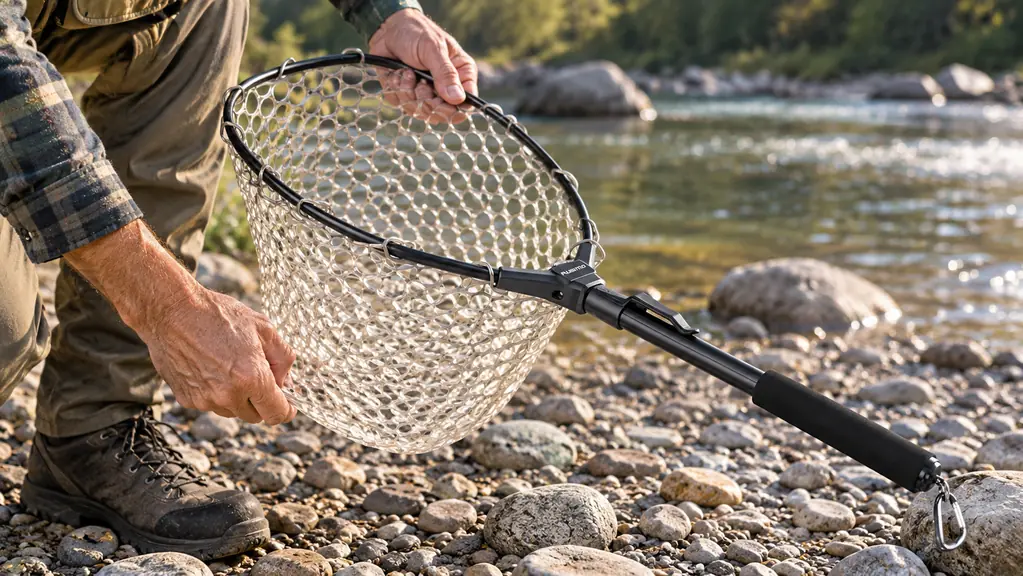
The folding handle is the reason this net exists, and it is also the part I judge hardest. A slider on an extending shaft is a wear item, the same as a flap actuator on an airframe. It works, it works, it works, and then one day it does not. What PLUSINNO got right is the surrounding structure: an aluminum alloy frame around the hoop and a total weight of 0.95 lb, so extending it does not feel like waving a fence post. Extended it reaches 28 inches. Collapsed it is 17. That 17 inches is the number that matters to me, because it means the net lies flat against my back on the hike in and does not snag on every alder branch between the truck and the water. I measured it against the tailgate the first afternoon, mostly out of habit. Seventeen inches collapsed puts the whole net inside the footprint of a standard canvas gear bag. Twenty-eight inches extended puts the hoop roughly where my hand already reaches when I am standing in knee-deep water, which is the point of a handle in the first place. On the Metolius in June I stood in a slot I have fished for years, rod in my left hand, and opened the net with my right thumb without looking down. That is the real test. If I have to look at a handle to open it, the handle is wrong, and this one passed.
Then there is the bag. Rubber mesh, 10 inches deep, hung in a 16 by 13 inch hoop. Rubber does three things nylon will not. It does not grab a treble hook, it does not strip the slime coat off a fish you mean to release, and it does not turn into a wet rag full of hook points by the end of the day. I have landed trout in the 12 to 18 inch range in this hoop all season and never felt crowded. The drop shape helps more than I expected. A 14 inch rainbow that came up in the current last September went straight to the bottom of the bag instead of sliding up the side, which is what happens in a shallow flat hoop. Ten inches of depth means a fish has somewhere to go that is not over the rim. On a 20 inch fish in fast water I would want more hoop, and I will say that plainly rather than pretend otherwise. Nobody lands a hot fish faster because their net is small.
Where the Frabill Floating Trout Net Wins
The Frabill does the one thing the PLUSINNO cannot do, and it does it without asking anything of you. It floats. Drop it in the Deschutes while you are trying to hold a rod and a fish at the same time and it will still be on the surface downstream, where you can wade to it and pick it up. The PLUSINNO has an aluminum alloy frame, and aluminum sinks. Clip it, leash it, or accept that a dropped net is a lost net. I watched a friend chase a net forty yards down the Crooked one August. He did not catch it, and he did not land the fish either. What I tried first on the PLUSINNO was a coiled lanyard off a vest D-ring. It worked for about a month and then it did not. The coil snagged on a willow while I was pushing through brush, stretched, and snapped back hard enough to sting my hand through a glove. A straight cord with a clip replaced it, which is better, but a cord is still a commitment. You cannot set the net down and walk twenty feet downstream to land a fish. The Frabill deletes that whole category of problem by refusing to sink.
The second concession is readiness. A fixed net is always open. When a fish takes and you are reeling with one hand and reaching with the other, a net you have to unfold is a net you are unfolding while the fish is still running. I timed it once in the driveway, out of curiosity. From clipped to open, unhurried, about two and a half seconds. That is not much. It is also not nothing when a fish is thrashing at your boots and your reel is still singing, and a fixed net scores a zero in that column, which is the right score for the moment. The Frabill's one-piece build also has almost nothing to break. No hinge, no slider, no spring, no magnet to lose. My folding net has more parts, and more parts means more places to inspect and more ways for a season to end early. That is not a knock on PLUSINNO specifically. It is arithmetic, and it applies to every folding net ever built.
The net that folds to 17 inches and still reaches 28
PLUSINNO built this one for people who walk in and fish light. Rubber mesh, aluminum alloy frame, 0.95 lb, and a magnetic release that keeps it flat against your back until your hand goes for it. Check the current price and the hoop measurement on the listing before you commit.
Amazon Check Today's Price on Amazon →What the Folding Mechanism Actually Costs You
A folding net costs you two things: seconds and maintenance. The seconds are real. When a good trout takes, you get maybe three seconds of chaos before you are dealing with a fish at your boots, and unfolding adds one of them. In practice I have not lost a fish to it, because I open the net while the fish is still running rather than when it is already at my feet. That is a habit, not a feature, and the net cannot build the habit for you. If you know you will not do it, buy a fixed net and be honest with yourself about why. There is a second cost nobody mentions, which is where your hands are. A net clipped to your back is fine until you need both arms for a stumble. I went down once on a slick rock shelf on the Crooked in March with one hand on the rod, and the net swung free on its clip and clattered across the rock. Nothing broke. I still spent ten minutes afterward checking the hinge for grit, because I did that for a living for thirty years and I cannot turn it off.
The maintenance is the part nobody puts on the box. Rinse the hinge in fresh water at the end of the day and let the net dry open, not folded. River silt is grit, and grit in a slider is what turns a smooth extension into a grinding one. Mine picked up a grainy feel near the halfway point in the second week of August the first season, which I traced back to a single afternoon of kneeling in a silty backwater. Twenty seconds with a hose and a drop of light oil fixed it. That is the whole program, and it takes less time than rigging a new leader. My truck is a 2011 Tacoma and the only reason it still runs is that I do the small scheduled things before they become large expensive things. Same principle, smaller stakes.

The Details I Check Before I Trust a Net
The attachment. The magnetic release and carabiner are the small engineering I actually appreciate, because they solve a problem I did not know I had until I carried a swinging net for a mile. Clip the release to a vest D-ring and the net hangs where your hand already goes. The magnet holds it against your back instead of slapping your hip with every step. It is a small idea, and it is the difference between carrying a net and being annoyed by one. The carabiner is the part I check first on any new one, because it is a stamped piece and stamped pieces are where a cheap build shows up before anything else does.
The frame. Aluminum alloy is the right call here. It is stiff enough that the hoop does not fold when a fish surges, and light enough that the net does not pull your vest sideways. The trade is that it sinks, which I have already covered and will not soften. If you fish from a boat or wade anything deeper than your waist, put a leash on it the day you take it out of the package, not the day after you lose one. Seventeen inches collapsed means it drops into a gear bag next to the wading boots. 0.95 lb means you will not notice it on the walk in. Both are the kind of number that only becomes obvious when they are wrong.
The mesh. Rubber is heavier than nylon and it holds water, so a wet net weighs more than the spec sheet says. What you get for that weight is a net that does not tangle and a fish that goes back the way it came out. The first season I used it I had a 13 inch brown roll in the bag with a dry fly still in its jaw, and the hook came free with one shake instead of weaving into the mesh for five minutes. That is the whole argument for rubber in one sentence. If you keep every fish you catch, this matters less to you. If you release everything, it matters more than the fold, more than the weight, and more than the magnetic release. It is the single most important thing on the net and it is the thing shoppers skip past.
What I Liked
- Collapses to 17 inches and clips flat against a vest or pack
- Extends to 28 inches, so you are not leaning into fast current
- Rubber mesh does not tangle and is gentle on released fish
- 0.95 lb on an aluminum alloy frame with a 16 by 13 inch hoop
- Magnetic release and carabiner keep the net where your hand already goes
Where It Falls Short
- The aluminum alloy frame sinks if you drop it
- Hinge and slider are wear items that need rinsing and drying
- A 16 by 13 inch hoop is tight for a big fish in heavy water
It weighs 0.95 lb, reaches 28 inches, and collapses to 17. It does the job of a long-handled net and then hides on your vest until the next fish.
Who Should Buy Which
Buy the PLUSINNO if you walk in to your water, if you fish creeks and small to medium rivers and Cascade high lakes, or if you want one net that handles trout and the occasional bass without taking up permanent real estate on your back. It is also the better choice for bank fishing, where you are often reaching down a steep edge and a longer handle earns its keep. I fish a handful of cut banks on the Crooked where the water is four feet below the rim, and 28 inches of reach is the difference between landing a fish and watching it come off at the lip. Leash it or clip it and the sinking problem mostly goes away. For the way most people actually fish most days, this is the net that gets carried instead of left in the truck.
Buy the Frabill if you wade big water and fish alone, if your hands are always full, or if you know from experience that you are the person who drops things. It floats, it is always open, and there is almost nothing on it to maintain. If you fish out of a boat, that last part matters more than any spec. And if you cannot be bothered to rinse and dry a hinge, do everyone a favor and buy the fixed net, because a neglected folder is worse than a simple one.
One decision, made with the specs in front of you
16 by 13 inch hoop. 10 inch rubber bag. 28 inches extended, 17 collapsed, 0.95 lb. If that fits the water you fish, you are done shopping. The listing has the current price and the full measurements.
Amazon See the PLUSINNO Landing Net on Amazon →