
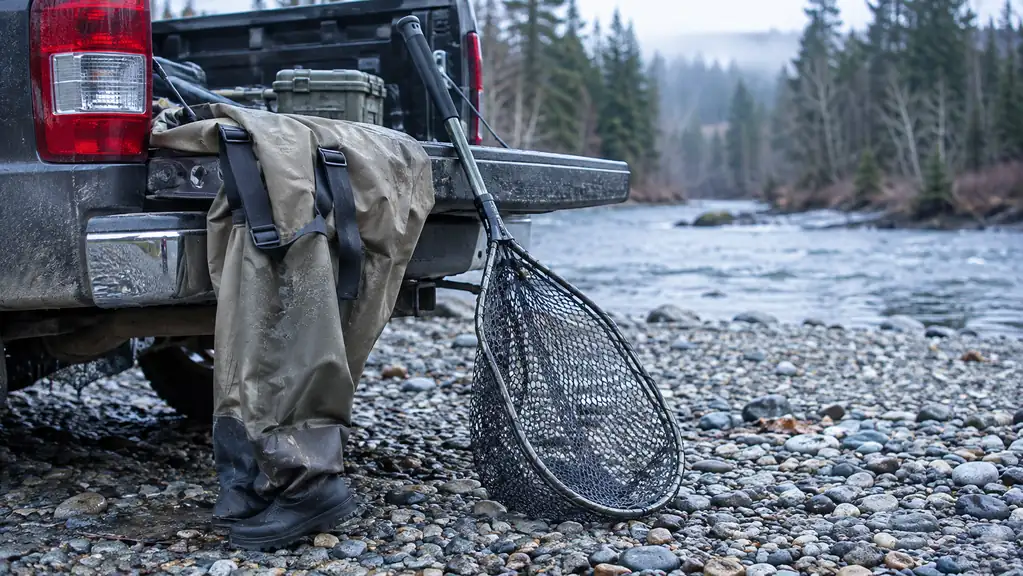
The landing net is the piece of fly gear that matters for about four seconds per fish, which is exactly why a bad one is so irritating. You spend the whole fight getting a trout close to hand, then the hoop either does its job or it does not, and there is no do-over. I have been carrying the PLUSINNO folding landing net on the Deschutes, on the Metolius and around a handful of Cascade lakes since early spring. I have netted enough fish with it to have an opinion that has nothing to do with how it looked coming out of the box.
The short version: it is light, it folds small, and the rubber mesh treats fish better than the knotted nylon I carried for years. It is not the net I would hand to somebody chasing a big steelhead. It is the net that now lives clipped to my vest for everything else, and I have mostly stopped thinking about it, which is the highest praise I can give a tool.
The Quick Verdict
A light, folding rubber-mesh net that does the everyday trout job well. The small hoop and the 10 inch bag are the honest limits, not defects.
Amazon Check Today's Price →The Net I Stopped Noticing on My Vest
Folds to 17 inches, weighs 0.95 pound, and hangs off a vest ring on a magnetic release until a fish needs it. If you wade and walk, this is the shape of net that does not get left in the truck.
Amazon Check Today's Price on Amazon →How I've Used It
I run a 2011 Tacoma with a canopy and camp out of it, so gear gets judged twice: once on the water, and once on how much room it eats behind the seat. The PLUSINNO folds down to 17 inches and weighs 0.95 pound. Laid flat it takes up less space than a paperback. That combination means it rides in the truck even on trips where I tell myself I am only scouting.
Most of my spring was on the Deschutes above Maupin, wading, swinging a streamer early and then nymphing the seams when the wind got up. The net hung off my vest on the carabiner and I forgot it was there, which is the entire point of a carry net. When a fish came to hand I unclipped it one handed, popped the frame open, and slid it under from behind. The hoop is 16 by 13 inches. That is a trout hoop, not a salmon hoop, and it is sized for the fish most of us actually catch.
The day it earned a permanent spot was a Tuesday in late April on the Deschutes, water still cold and a little off color, wind coming straight upstream at fifteen or so. I had been dragging a stonefly nymph under an indicator for three hours without a touch. When a fish finally ate, it turned out to be a fat 15 inch rainbow that ran straight at my legs. I had the net open in one hand before the fish was inside ten feet of me, and I scooped it clean from behind without stepping back. That is the whole job. Open, scoop, done, one hand, no fumbling.
On the Metolius, where the fish are educated and the banks are stacked with blowdown, the folding part earned its keep. I could collapse it and shove it into the back of the vest while I scrambled through deadfall, then have it open again in about two seconds when I reached the pool. In July I carried it on a pack strap up to a high lake and used it from a float tube, mostly to lift a fish for a quick look before letting it go.
What the 16 by 13 Hoop Actually Does
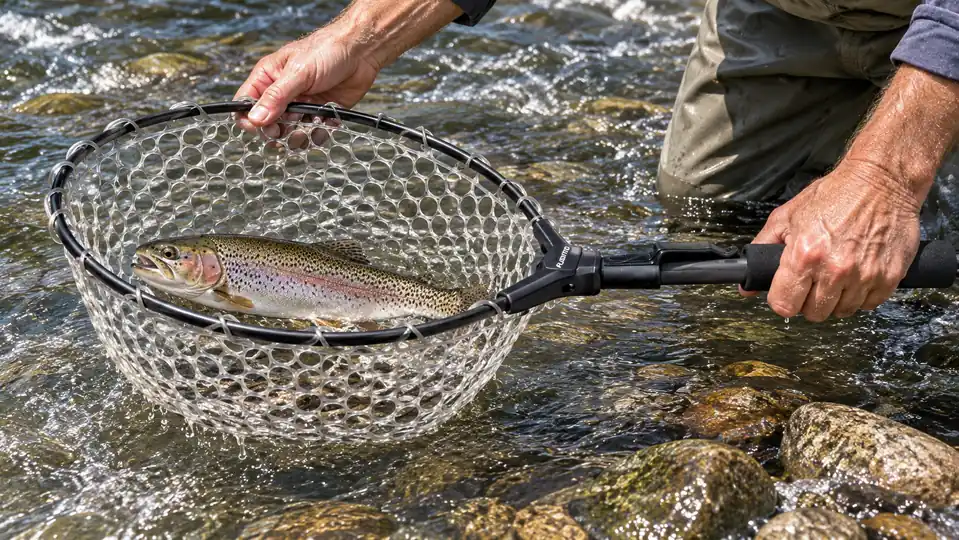
Hoop size is where most net buying goes wrong. People buy for the fish they dream about instead of the fish they catch. A 16 by 13 inch hoop with a 10 inch deep bag is right for trout in the 8 to 18 inch range, which covers most of what most of us bring to a fly rod. I have slid 14 inch rainbows into it without touching the frame. I have also had one hot fish around 17 inches come over the top of the bag and back out, and that told me what I needed to know about the ceiling on this net.
Something worth knowing about how a fish sits in this net: the bag hangs off a drop shaped hoop, so the bottom of the bag trails downstream when you hold the frame at an angle in current. That is a good thing. The fish settles into the low point instead of bouncing off a flat bottom, and you can keep the frame half out of the water and still have the fish fully supported. That 10 inch depth is measured on a slack bag. In current it hangs deeper, which buys you a little room on a fish slightly bigger than the net was designed for.
The rubber mesh is the part I would pay for on its own. Small flies come out of it without a fight. I buried a size 16 Blue Wing Olive pattern in the bag one afternoon, and it came free with a single pull instead of the ten minutes I used to spend picking a knotted nylon bag apart with forceps. More important, fish come out of it in better shape. Wet rubber slides. It does not rasp, and it does not shave the slime coat the way old mesh did on a fish I was planning to release.
The mesh also does not hold water the way nylon does. You shake it once and it is done dripping. That sounds like a small thing until you have carried a soaked net against your back for four hours on a windy afternoon.
The Handle, the Fold and the Magnet
The frame is aluminum alloy and the handle is listed as a composite material, and the whole thing comes in at 0.95 pound. Extended, the net runs 28 inches from the butt of the handle to the top of the hoop. Collapsed, it is 17 inches. That is a short handle by boat-net standards. It is a fine handle for wading, where you are reaching down and forward rather than out over a gunwale.
I measured it against my forearm out of curiosity. Collapsed at 17 inches it is a bit shorter than the distance from my elbow to my fingertips, so it drops into a pack lid or the back of a vest without arguing. Open at 28 inches it puts the hoop roughly where my hand naturally reaches when I am bent forward over a fish in knee deep water. What I did not expect was how little the collapsed bundle rattles. The frame folds flat against the handle instead of dangling, so it does not clack when you walk, which on a quiet river matters more than it should.
The fold mechanism is the piece most likely to fail on an inexpensive net, and it is the piece I have watched closest. A couple of seasons back I owned a different folding net that developed a wobble at the hinge inside a month, and it got worse until the hoop would not stay open under a fish. That is the failure mode that costs you a fish you wanted a photo of. The PLUSINNO hinge has stayed tight through a full spring and summer. I open and close it every trip, sometimes twenty times in a day, and there is no rattle and no slop in the joint yet.
The magnetic release on the carabiner is a small thing done right. You clip the carabiner to a vest ring or a pack loop, the magnet holds the net flat against your back, and you pull it free when a fish comes. Re-hanging it takes practice one handed. I dropped mine into the shallows twice in the first week because I let the hoop swing while I was hunting for the magnet with my other hand. By the third trip the motion was automatic and it stopped being a problem.
How It Has Held Up Over Months
The honest test of any fishing tool is what it looks like after a season of being dropped on gravel and left wet in a truck bed. Mine has a couple of scratches on the aluminum, some grit marks on the handle, and one small dent in the rubber where I set it down on a rock the wrong way. The mesh has not torn, not even along the seam where it joins the frame, which is where I expected trouble first. It has not gone soft or gummy in the sun either.
I went over it in the driveway one evening in August with a rag and a flashlight, the way I used to inspect a part coming off an airframe. The hinge pin showed no wear. The aluminum frame had a couple of shallow scratches and nothing that caught a fingernail. The rubber mesh was still supple, and the seam where the mesh wraps the frame had no frayed strands and no pulled stitches. The only real mark was a scuff on the composite handle where it had ridden against a rock in the truck bed all summer. Nothing in that inspection worried me.
Two things I would flag honestly. First, the handle flexes. Not much, but you can feel it when you are lifting a fish clear of the water one handed with the net extended. It has not failed and I do not expect it to, but it is not a stiff carbon handle and it does not pretend to be. Second, the 10 inch bag depth is the real limit of this net. A big fish can come over the rim. Neither of those is a defect. They are the trade you make for a net that folds to 17 inches and weighs under a pound.
What It Weighs on a Long Walk
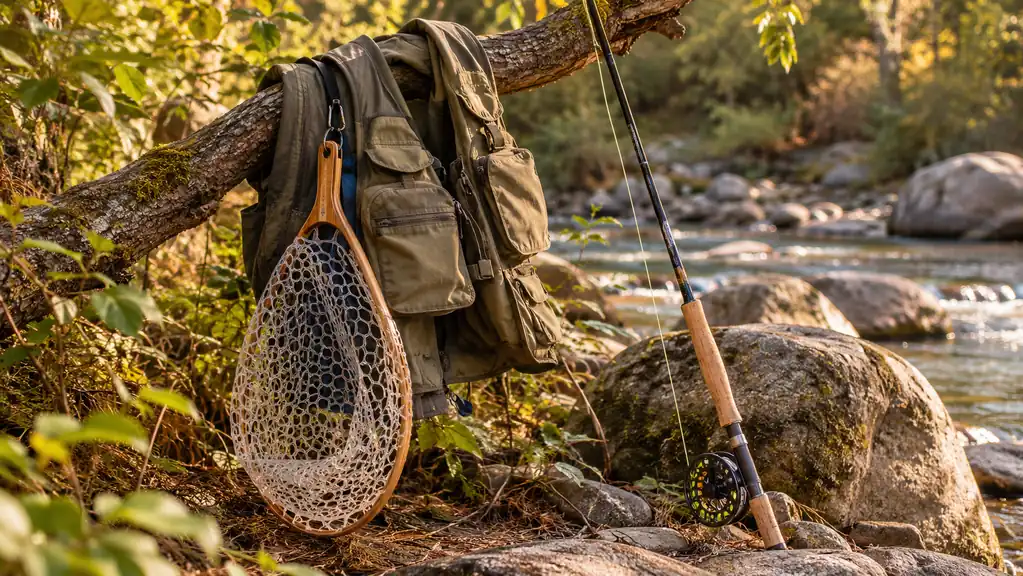
I walk a lot of water, usually two to four miles in a session, and net weight matters more than people admit. Under a pound riding on a vest ring is invisible. The net I carried before this one weighed closer to two pounds with the bag soaked, and by the end of a long day I noticed it in my shoulders. This one I do not notice at all, and because I do not notice it, I do not leave it behind to save the weight.
The carabiner and magnet setup matters here too. A net that swings on a lanyard thumps against your back on every step. This one sits flat against the vest and stays put, and when I bend over to release a fish it does not swing forward into the water. Small engineering, but it is the kind of detail that decides whether a tool goes with you or stays in the truck.
What I Liked
- Rubber mesh does not tangle flies and is easy on fish you intend to release
- Folds to 17 inches and clips flat to a vest or pack on the magnetic release
- Under a pound at 0.95 pound, light enough to forget you are carrying it
- Aluminum alloy frame and hinge have stayed tight through months of opening and closing
- Shake it once and the rubber bag is dry, no soaked net against your back
Where It Falls Short
- 16 by 13 inch hoop with a 10 inch bag is a trout net, not a big-fish net
- Composite handle flexes under load when you lift a fish one handed
- Re-hanging it on the magnet one handed takes a few trips to get smooth
- 28 inch extended length is short for reach from a boat
A size 16 Blue Wing Olive came out of that rubber bag with one pull. The old nylon net would have cost me ten minutes and a knotted tippet.
Who This Is For
This is a wading net for trout. If you fish the Deschutes, the Crooked, the Metolius or any of the smaller water where you cover a few miles on foot and cast to fish in the 8 to 18 inch class, this net is sized correctly for that day. It clips to a vest or a pack, it weighs almost nothing, and it will not eat your flies. It is the net I reach for when I am walking and the fish are ordinary size, which is most days.
It is also a good second net. If you already own a big boat net and want something that stays in the truck for the times you decide to pull over and wade, the PLUSINNO does that job without eating space. And if you are new to fly fishing and do not want to spend real money on a net before you know whether the sport sticks, this one does the core job for a beginner without being a toy.
Who Should Skip It
If you chase steelhead, big browns, pike or anything else that does not fit in a 16 by 13 inch hoop with a 10 inch bag, skip it. You will lose fish over the rim and you will be annoyed about it, correctly. Buy a boat net with a deep bag and a long handle and accept that it does not fold into a vest.
If you fish mostly from a drift boat, where the net lives in a holder and never gets carried, the folding and the light weight buy you nothing. You would rather have a stiff handle and a deeper bag. And if you want a net that opens from fully collapsed in one clean motion with zero learning curve, plan on a few trips of fumbling with the magnet before it feels natural.
Sixteen Inches of Rubber Mesh, Half a Season of Trout
If your water is trout water and your feet are in the river, this is the right size and the right weight. Folds to 17 inches, hangs off a vest ring, and comes out of the bag dry.
Amazon Check Today's Price on Amazon →