
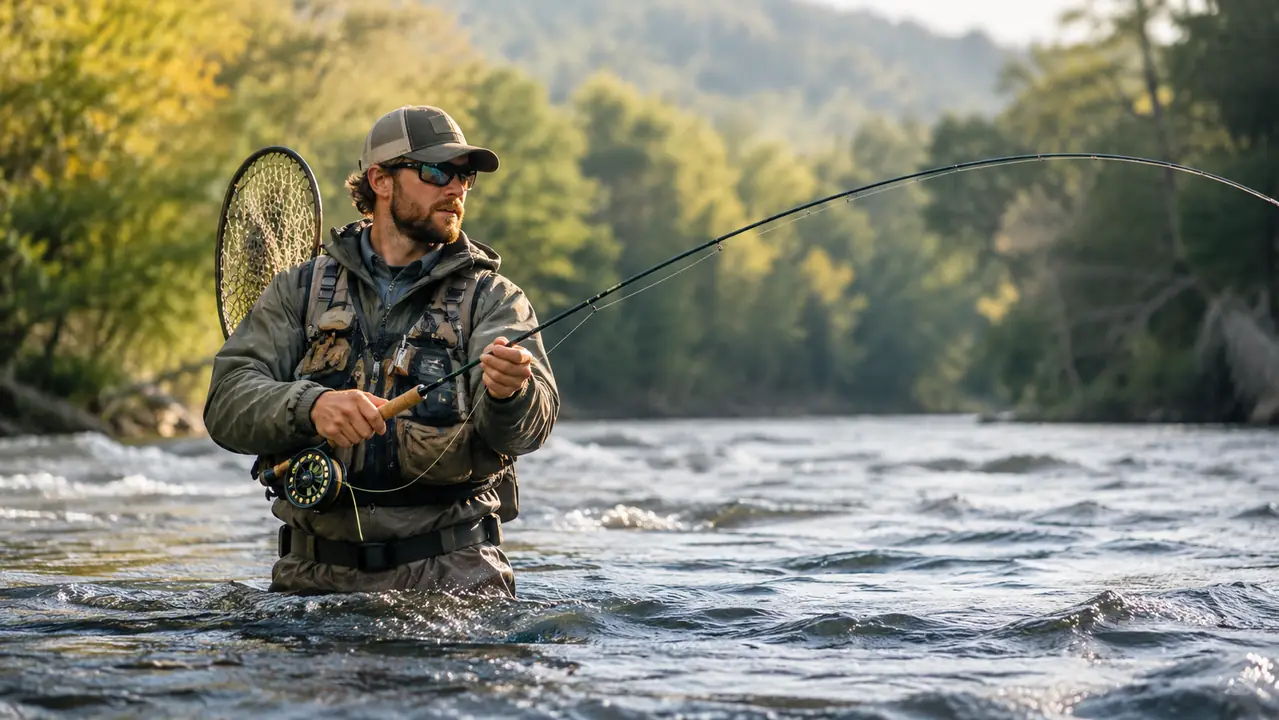
The first trout I ever tried to net on the Deschutes came off about a foot from the bag, and I stood in the current holding a wet net and feeling like a man who had just dropped a socket into an engine bay. The fish was fine. My pride took a while. What I have learned in the twenty-five years since is that landing a trout is not a strength contest and it is not luck. It is a sequence. The net is one part of that sequence, and it is not even the part most people get wrong.
Most trout lost at the net are lost before the net touches water. The angler rushes the last ten feet, the line goes slack, the hook falls out, or the fish makes one hard turn and the tippet parts on a rock. A landing net only fixes that if you use it in the right order, and if it is a net you will actually carry. The one clipped to my vest is the PLUSINNO folding net. The hoop is 16 inches by 13 inches, the bag is 10 inches deep, it folds down to 17 inches for the walk in, and it weighs 0.95 of a pound. That last number is the reason it comes with me. A net left in the truck is a net that does nothing. Here is the sequence I use, in the order I use it.
A net you will actually carry, which is the only kind that works
The PLUSINNO folds to 17 inches and weighs under a pound, with a 16 by 13 inch hoop, a 10 inch bag, and rubber mesh that will not strip a trout's slime coat. It clips to your vest with a magnetic release and stays out of the way until the moment you reach for it.
Amazon Check Today's Price on Amazon →Step 1: Rig the Net Before You Rig the Rod
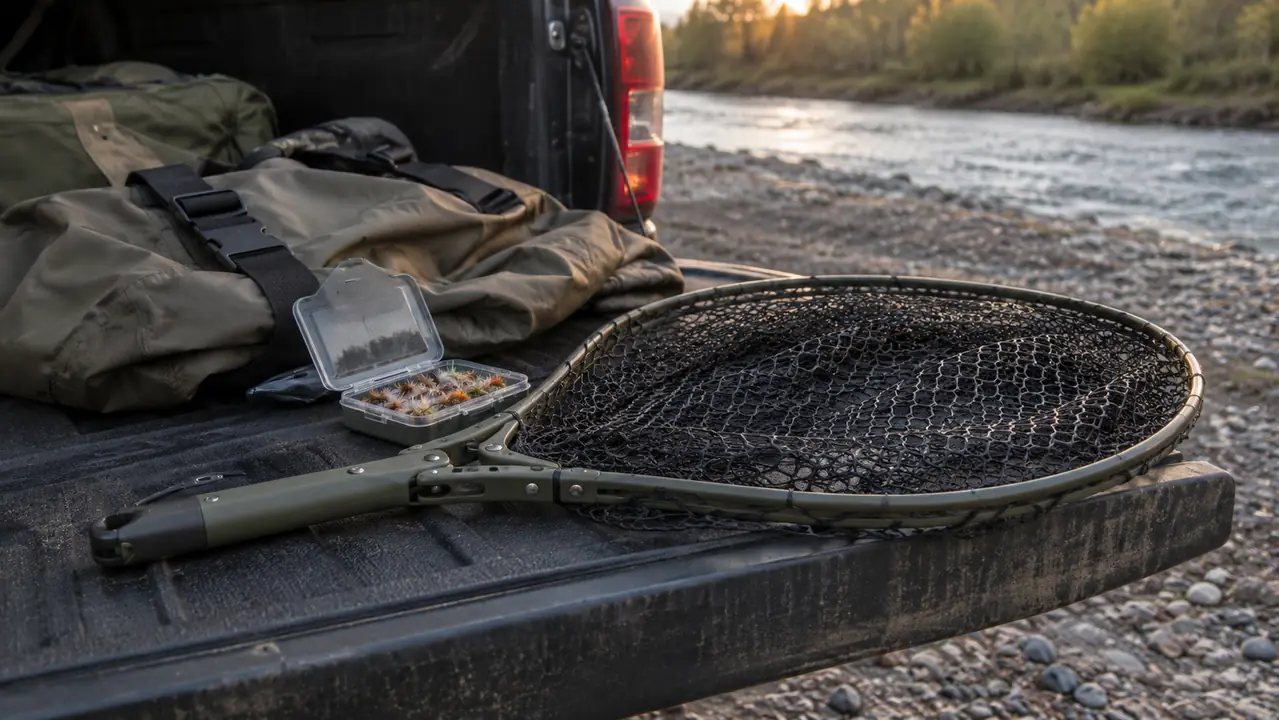
I rig the net first, standing at the tailgate of the Tacoma with everything laid out flat where I can see it. The net comes out of the folded position and I check the hinge and the frame. Then the magnetic release gets clipped to a D ring high on the vest, chest height, on the side I do not cast from. Chest height matters. When a fish is close and you reach, you want to find the net without looking down at your own body.
I do this on the tailgate because it is flat, it sits at waist height, and nothing small can roll into the gravel and disappear. A D ring on the vest, a pack strap, a wader belt loop: any of those works. What does not work is clipping the net to the back of your vest and hoping. You will not reach it in time, and you will not be able to see whether the magnet actually caught.
I watched a friend spend a solid thirty seconds wrestling a net off his back while a good rainbow sat in the current and eventually decided it had better things to do. Thirty seconds is a long time when a fish is hooked. The magnet holds the net against your vest while you wade and lets go with one hand when you pull. The carabiner on the PLUSINNO release goes onto a vest loop or a pack strap without any extra hardware, which is one less small part to lose in the gravel.
Two checks before you wade. The carabiner gate closes all the way, and the magnet sits flat against its plate. Both take about three seconds. I did the same thing with a torque wrench before a job: look at it, then trust it.
Step 2: Play the Fish Until It Is Actually Ready
A trout with any steam left in it will not go into a net head first. It will turn, and if the hook is hanging by a thread, that turn is the end of the story. Keep the rod bent and keep steady pressure on. Let the fish run when it wants to run. On the Deschutes in June you may be standing waist deep in fast water with a fish that has no interest in meeting you and a current that wants to take your feet out from under you.
Two Junes ago I had a rainbow that taped at 17 inches, hooked in fast water above a rock ledge, and I made myself wait. It ran four times. Each run I let it go and kept the rod bent. By the fifth minute it was sliding sideways and I still gave it another thirty seconds. That fish went into the bag on the first pass, because the fish was done before the net ever moved.
You will know it is ready when the short violent runs stop. The fish starts to slide. It comes up and rolls. It lets you lead it instead of deciding for itself where it is going. That is when you reach for the net. Reach earlier and you are guessing.
This matters more with barbless hooks, which is what I fish. A barbless hook stays put because there is constant tension on it. The moment you ease off to grab the net with your other hand, you have handed the fish its opening. Keep the rod loaded until the hoop is in the water.
Step 3: Put the Hoop in the Water and Lead, Do Not Scoop
Most fish are lost right here. People swing the net at a trout like they are trying to catch a butterfly. The hoop travels fast through the air, hits the surface, throws a wave, and the fish either spooks or the slack line pulls the hook. The net should be in the water and still before the fish arrives.
The first season I fished with a net I swung it more than once, and I have the memory of a wave spreading out from the hoop to prove it. That wave does two things. It tells the fish something large is above it, and it lifts your fly line off the water, which puts slack exactly where you cannot afford slack. Sink the hoop slow and quiet, an inch at a time, and let the surface stay flat until the fish is over it.
Sink the hoop a few inches and hold it there. Lead the trout head first over the rim. The 10 inch bag gives the fish somewhere to go once it is over the hoop, so it does not bounce back out over the edge. A shallow bag turns a landed fish into a coin flip, and I have used shallow bags. I have no plans to go back to one.
Position the handle downstream or off to the side so it stays clear of your fly line. In current, put the net below the fish and let the river do part of the work for you. Then lift straight up. Do not pry, do not lever, and do not lift the frame by the far side of the hoop. Straight up, the way you would close a valve.
You do not scoop a trout. You put the hoop where the fish is already going and let the river walk it in.
Step 4: Keep the Fish in the Water While You Unhook It
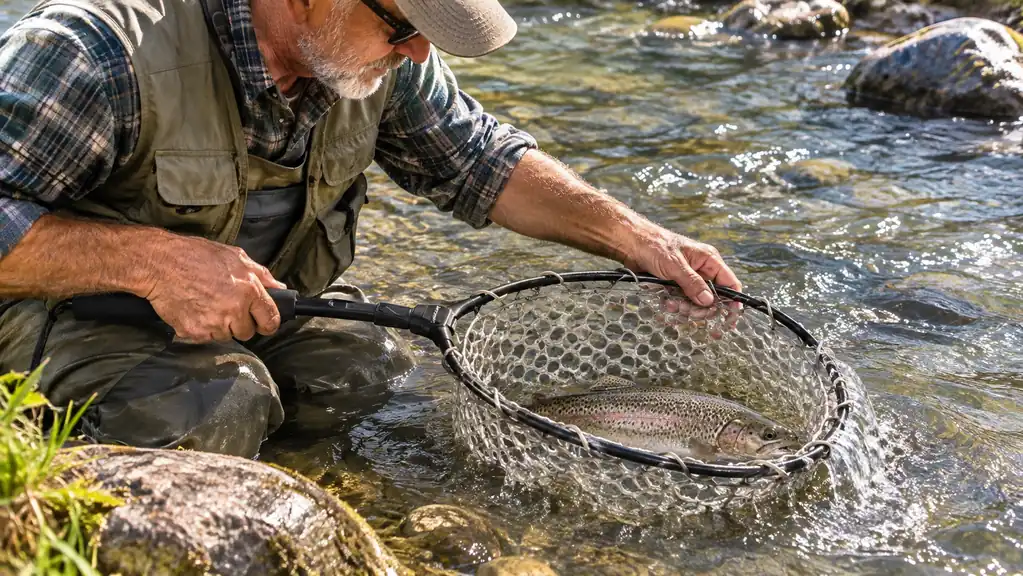
Leave the bag in the water. Wet your hands before they touch the fish. The rubber mesh is the reason I care about mesh at all. It does not sand the slime coat off a trout the way a hard knotted bag does, and a hook does not bury itself in it. When a fly comes out of the mesh easily you spend less time handling the fish, and less time handling the fish is the entire point.
The bag is 10 inches deep, which is enough that a trout will not flip out while I am reaching for forceps, but not so deep that the fish is buried and I cannot see what I am doing. That is a narrower window than it sounds. I have used nets where the bag was deep enough that I was searching around the bottom of it by feel while the fish waited, and I did not care for it.
Reach in with forceps, back the hook out the way it went in, and keep the fish in the water the whole time. If you want a photograph, the fish comes out for a few seconds and goes straight back. Support it under the belly and just in front of the tail, keep your fingers out of the gills, and do not hold it up by the jaw the way you see in the magazines. A trout's jaw is not a handle.
If you are fishing alone and the hook is deep, use the net as a holding pen. The bag gives you a place to keep the fish still while both hands are busy. That is worth more than any feature on the frame.
Step 5: Revive, Release, Then Stow the Net
Point the fish into the current and hold it upright until it holds itself up. On the Crooked in August the water is warm and that can take longer than you would like, which is a decent argument for fishing that river early instead of at two in the afternoon. Let it go when it is ready. If it rolls over, pick it up and start the count again.
Then stow the net properly. Fold it back down, shake the water out of the bag, and hang it somewhere it can dry when you get home. Rubber mesh left wet in a hot truck cab all week is not doing itself any favors. Mine hangs off a nail in the garage next to the waders, where I will trip over it on the way out and remember to take it.
Folded, the net is 17 inches, which slides behind the seat of the Tacoma or into the side pocket of a daypack. I hike into the Cascade lakes a few times each summer, and that folded length is the difference between carrying a net and leaving it in the truck. Extended, it is 28 inches, which is enough reach from a high bank or a log.
What Else Helps
Forceps on a zinger, and a second pair in the pack. Barbless hooks, pinched flat, because they come out of a fish and out of your sleeve with equal ease. A spool of tippet one size heavier than you think you need, since the last ten feet of a fight happen in the heaviest water of the day. Polarized glasses so you can see the fish before it sees you.
Keep a small rag in the vest pocket. Wet hands are the rule, and the rag is not for the fish, it is for your glasses and your phone. Carry a hook sharpener too. A barbless hook that has been dragged over rock twice will not hold anything, and a dull hook costs you fish in a way that looks exactly like bad luck.
A folding net has one more joint than a fixed frame does, and joints are where things loosen. Twice a season I open it up, check the hinge for play, and rinse the grit out. That is the tradeoff you accept for a net that fits in a pack. It is the same tradeoff as any folding tool: you give up a little rigidity to gain portability, and then you maintain it like an adult.
One more thing. The hoop on the PLUSINNO is 16 by 13 inches, which is right for trout and smallmouth. If you are chasing steelhead or big pike, buy a bigger hoop and a longer handle. Taking a trout net out after fish it was never built for and then blaming the net is not a fair test of anything.
The last ten feet of the fight go better with a net on your vest
16 by 13 inch hoop, 10 inch rubber bag, aluminum alloy frame, folds to 17 inches, 0.95 of a pound. It clips on with a magnetic release and comes off with one hand, which is the only kind of net that gets used.
Amazon Check Today's Price on Amazon →