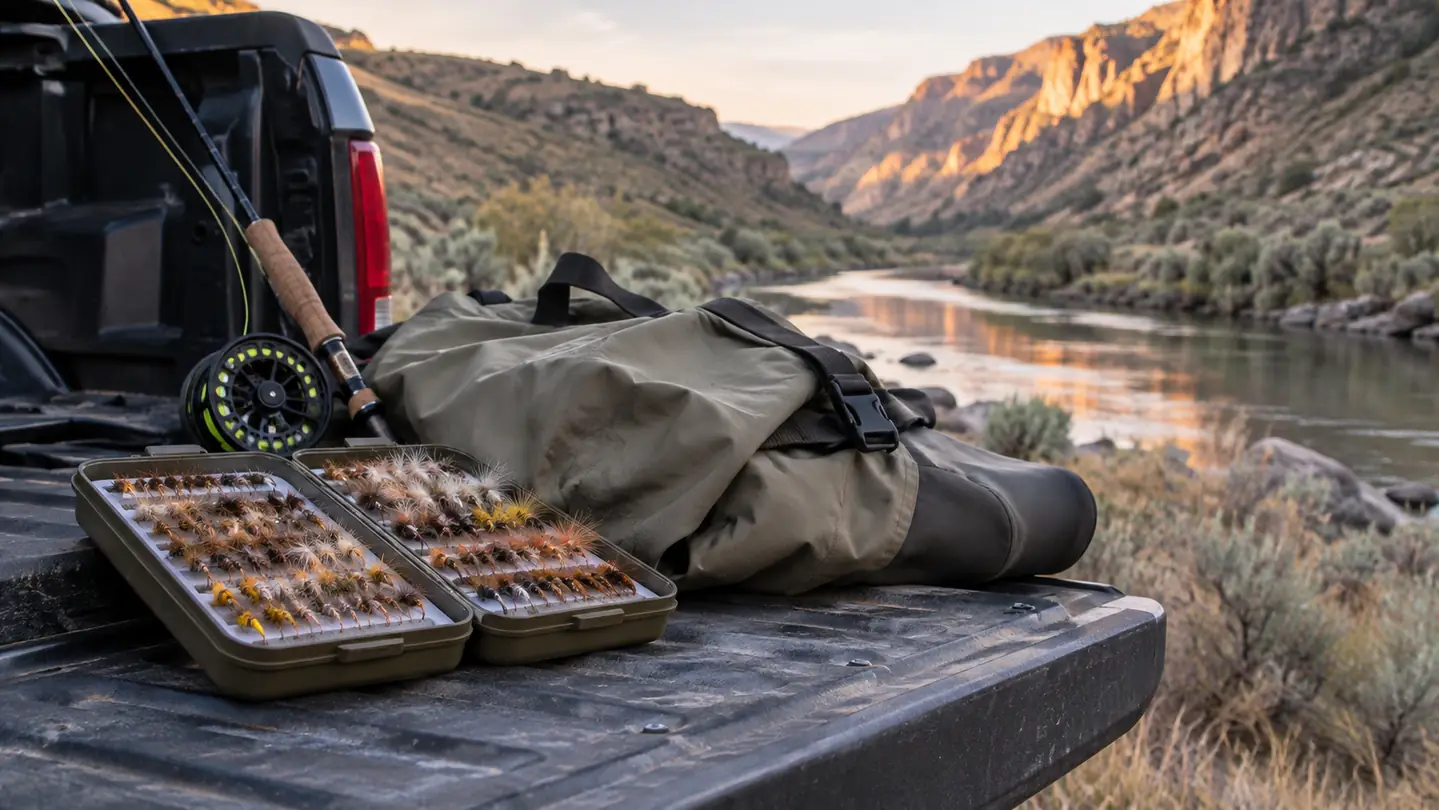
I bought the BASSDASH 64 piece fly kit for an unglamorous reason. I was losing flies faster than I was tying them, the willows on the Crooked River eat anything you hang in them, and I wanted a box I did not have to think about. That is not the reason a catalog wants you to buy it. But it is the honest reason, and after two seasons of carrying this thing in the Tacoma and on the water, I have a fair idea of what it does well and where it disappoints. The disappointing parts are the ones you rarely read about, so I will lead with those.
Start with the thing nobody mentions. This is not sixty four flies you will fish. It is maybe fifteen flies you will fish hard, forty you will fish once out of curiosity, and a handful that will sit in the box until you give them away. That is true of nearly every assortment ever sold, and pretending otherwise is how these kits end up returned. Once you accept the real ratio, the kit starts making sense as a cheap way to learn what the fish in your water want before you spend a winter at the vise.
The Quick Verdict
A good starter box and a poor substitute for knowing your water. Buy it to learn patterns, not to fill a boat box.
Amazon Check Today's Price →See What Is Actually in the 64 Piece Kit
Seven fly families, one compact box, and enough variety to figure out what your river wants. Check the current pattern list and today's price before you commit.
Amazon Check Today's Price on Amazon →How I Have Actually Fished It
Most of my time is on the Deschutes and the Metolius, with a handful of summer trips up into the high lakes in the Cascades. Those are three different jobs. The Deschutes is big water and wind. The Metolius is clear and technical and those fish have seen everything. The high lakes are hungry fish in cold water that will take almost anything presented without a splash. A kit like this lives or dies on whether it covers those three. It covers two of them well.
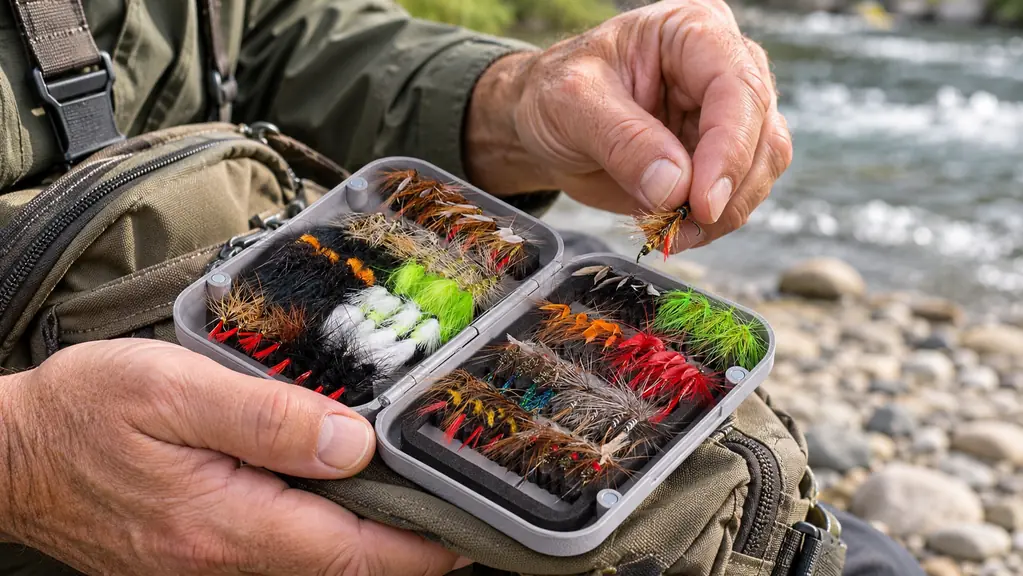
The box itself is the part I did not expect to like. It measures 3.94 by 2.76 by 1.18 inches, so it disappears into the front pocket of a chest pack instead of hanging off a lanyard and swinging around when you wade. The lid closes on a magnetic fastener. I have opened and shut that lid several hundred times now, in wind, with cold hands, with a fly pinched in my teeth, and it has never popped open in the pack. That sounds like a small thing until you have spent an evening untangling a loose pile of dressed hooks.
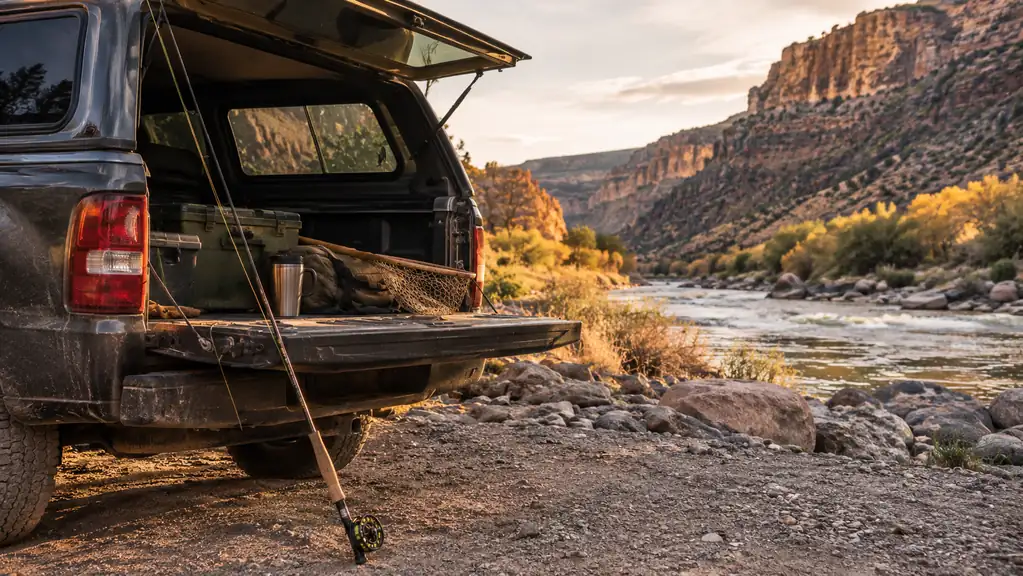
The first season I carried it wrong. I treated the box as a backup and left it in the truck, which meant I never used it and learned nothing from it. The second season I clipped it to the front of the pack and made myself open it first, before my usual box. That is the only way an assortment teaches you anything. You have to fish the unfamiliar patterns on purpose, on days when you could be catching fish on the familiar ones.
The day it earned its place was a cold morning on the Crooked below the dam. I had one dry fly box and this one. The fish were up but not committed, and I changed patterns four times in twenty minutes, which is exactly the fidgety kind of fishing this kit is built for. Digging through sixty four slots to find one fly is faster than walking back to the truck. That is the whole argument for carrying an assortment, and it holds.
Deschutes wind is the other test, and it is a fair one. A light box swinging on a lanyard becomes a nuisance in an upstream blow. This one sits in a pocket and stays there. I have had it out on days when I needed one hand to hold my hat on, and the lid still opened and shut without dumping flies into the boat. That is not a feature the listing mentions and it is the one I think about most.
What Nobody Tells You About the Box
The magnetic closure is the best thing in the kit, and it is also the reason the box is as small as it is. There is no hinge hardware to speak of and no latch to break. From a maintenance standpoint that is the right call, because the failure point on most inexpensive fly boxes is the latch, not the foam. A magnet does not wear out on a schedule. It either holds or it does not, and this one holds.
The tradeoff is that sixty four flies in a box that size means the compartments are tight. Flies sit close together and the feathers get bent. If you are fussy about your dries keeping a perfect collar, this will annoy you. If you are the sort of person who straightens a feather with a thumbnail and moves on, you will not care. I fall in the second group, but I want to be straight that the first group exists.
One more thing nobody says out loud. A compact box with a magnetic lid is not waterproof, and this one does not pretend to be. Mine has been rained on and it has been fine, because I open it, dry what got wet, and leave the lid open on the dash overnight. If you close it damp and leave it in the truck for a week, you will find out what steel hooks do in a humid box.
The Pattern Mix Is Uneven, and That Is the Real Story
The listed contents are Mayfly dries, streamers, leeches, wet flies, terrestrials, miscellaneous dries and caddis dries. Seven families across sixty four flies means none of them gets a deep bench. You are getting a sampler, not a working collection. In practice the streamers and leeches were the most useful on the Deschutes, the caddis dries were the most useful on the Metolius in June, and the terrestrials were what I reached for in August when the grasshoppers got clumsy.
What that means for you is simple. Count how many of each family you actually got, compare it to what hatches on your home water, and expect to supplement. If you fish a river with a heavy October caddis emergence, this kit will not carry you through it. If you fish a general trout river through a general season, it will cover most of your days.
One thing that surprised me was how much use the wet flies got. I have always been a dry fly snob in summer and a streamer guy in the fall, and the middle of the season I used to spend staring at a dead drift. The wets in this kit gave me something to do when nothing was coming off the water. A swung wet through a tailout is a pleasant way to spend an hour even when it does not produce.
The high lakes are where the assortment punches above its class. Fish up there have short seasons and long winters and they are not picky. A leech and a small wet fly will do most of the work, and the kit has both, in enough variety to sort out what they want that week. I have had mornings where the difference between a good day and a skunk was having three leech patterns in the box instead of one.
Hooks, Materials, and Where the Corners Got Cut
The hooks are metal with a spear point, and the BASSDASH listing gives panfish as the target species even though the product title says trout and bass. That mismatch is worth reading carefully, because it tells you what the kit was built around. A spear point is a general purpose point. It is not the sharpest thing out of the box and it is not the toughest, but it holds well enough on the fish most people catch most days.
The dressing is where the money was saved. On a fly tied to last, you can feel the thread tension and see how the feathers were wound. On these, the dubbing is thinner, the feathers are sparser, and the tails run shorter than a careful tier would make them. None of that stopped fish from eating. Fish are not grading your fly against a photograph. But thin dressing comes apart sooner, and it does, usually after a few fish or a few snags.
A note on the points. They are serviceable, not sharp. I run a small file over the ones I expect to fish before a trip and it takes about ten minutes. If you have never touched up a hook, this is a fine place to learn, because ruining an inexpensive fly while you learn is a lot less painful than ruining one you tied yourself.
The real fix is not to baby them, it is to dry them. I pop each fly out of its slot after a day on the water, set it on the dash of the Tacoma while I drive home, and put it away dry. Since I started doing that I have had very little rust and almost nothing fall apart in the box. The flies that went back wet are the ones that turned into little pom poms by August.
Storage matters more than people think. Mine lives in a small plastic tub in the truck with a couple of silica packets, which is a cheap fix that has kept the hooks from turning. If you keep the kit in a boat compartment that fills with water, no amount of drying on the dash will save it. Put it somewhere dry and it will last. Leave it wet and it will not, and that is true of every fly box ever made, this one included.
What It Actually Catches, and What It Does Not
Honest accounting. Trout on the Deschutes took the streamers and the larger dries. Metolius fish took the small caddis dries and refused most of the rest, which is a Metolius problem and not a kit problem. High lake fish took leeches and wets without much discussion. I have not fished it for bass, though the title claims them, and I would not expect a kit aimed at panfish to have the hook gap for a serious largemouth.
These are general purpose imitations. They suggest a mayfly, they suggest a caddis, they suggest a leech. On water where the fish are educated, a suggestion is not enough. On water where they are not, a suggestion is plenty. Most of us fish a mix of both, which is why a box like this ends up more useful than a purist would predict.
What it will not do is solve a selective emergence. If the fish are on one specific mayfly and you do not have that exact size and silhouette, no assortment saves you. That is when you drive to a fly shop and buy six of the right thing. The kit is a foundation, not a substitute for that errand, and I would rather say so than sell you a fantasy.
I have also fished it in the fall, which is a different season with different expectations. The streamers did the work, as they always do, and the dries mostly stayed in the box. That is not a knock. It is the honest shape of a general assortment: strongest in the middle of the season, weakest at the edges, and most of us fish the middle.
What I Liked
- Box is compact and disappears into a chest pack pocket
- Magnetic lid has held up over two seasons with no latch to break
- Covers seven fly families so you can learn what your water wants
- Inexpensive enough that losing flies does not sting
- Genuinely good starting point for high lakes and general trout water
Where It Falls Short
- Uneven pattern distribution means you will supplement quickly
- Dressing is thin and comes apart after a few fish
- Not waterproof, so wet flies rust if you close the box damp
- Spear points need touching up before a serious trip
- Wrong tool for a selective emergence or a real bass program
Sixty four flies is not sixty four flies you will fish. It is a cheap education in what your river wants, and that is worth having.
What I Would Change If I Ran the Company
If I were running BASSDASH, I would change two things. I would thin the miscellaneous dries and put that space toward more caddis and more terrestrials, because that is where the kit earns its keep. And I would print the pattern list inside the lid, so a beginner can look at a fly and know what it is meant to imitate without hunting for a photo online. Neither change costs much. Both would make the kit teach faster, and teaching is the whole job here.
Who This Is For
If you are new to fly fishing, or coming back after years away, or you want one box in the truck that covers a weekend on three kinds of water, this is the kit. It works as a gift for the same reason, since it arrives with its own box and gives somebody something to open and something to fish the same afternoon. And if you fish ten days a year and do not want a wall of boxes, the assortment covers you fine.
It is also the right buy if you are still deciding whether you like this enough to tie. An assortment is cheaper than a vise and a materials bench, and it tells you which patterns you reach for. If you find yourself wanting a better version of the same three flies in November, that is your answer, and you will have gotten there without guessing.
Who Should Skip It
Skip it if you already know your water. A Deschutes regular with a box of proven patterns gains nothing here. Skip it if you fish specific hatches on purpose, if you tie, if you chase big bass, or if you are hard on gear and expect a box to survive being closed wet and left in the boat. Skip it too if you want a waterproof box, because this is not one and it does not claim to be.
What I Would Tell a Friend
Two seasons in, the honest summary is that the box outlived my expectations and the flies met them exactly. That is a good trade. Buy it expecting a starter education and a place to keep what you learn, and you will be happy. Buy it expecting a complete collection that ends your trips to the fly shop, and you will be disappointed by July. The BASSDASH kit is a solid first box. It is not the last box you will own, and it never claimed to be.
Start With a Box You Can Learn From
Sixty four flies across seven families, in a compact box with a magnetic lid that has held up for two seasons. Check today's price and the full pattern list on Amazon.
Amazon Check Today's Price on Amazon →