
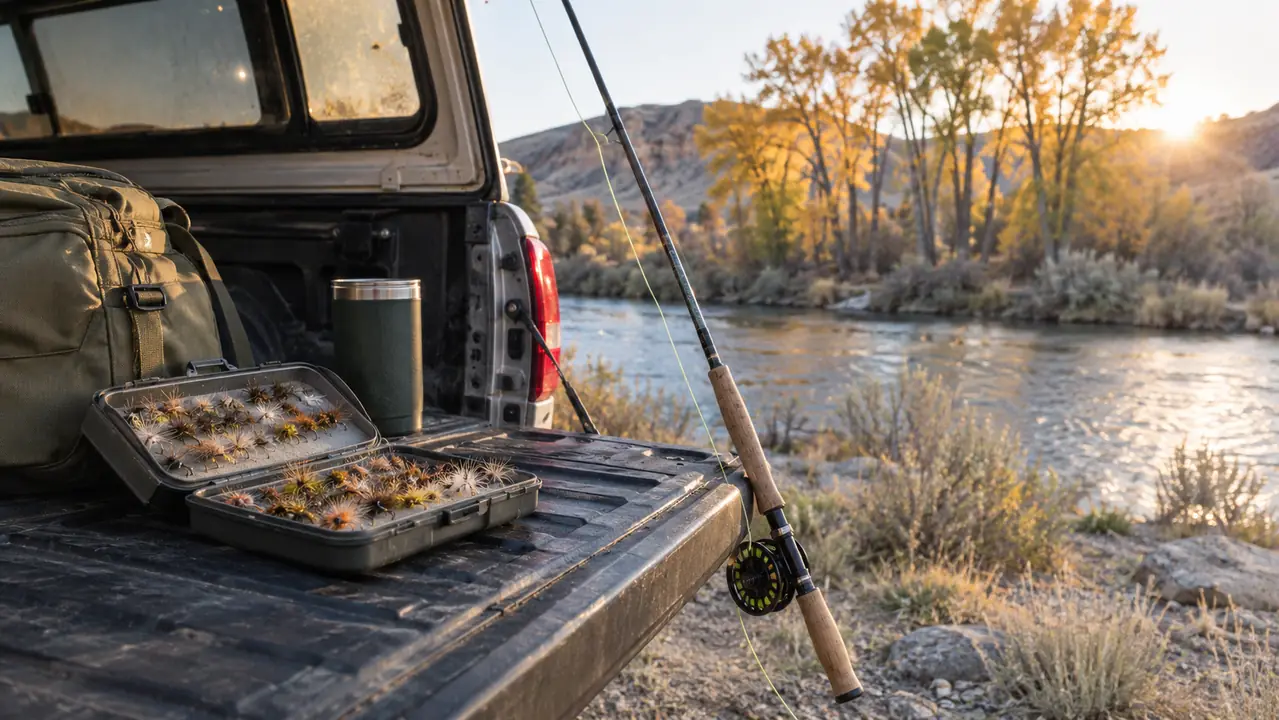
I have a fly box that has ridden in the same vest pocket for over a decade. Maybe a dozen patterns in it, tied by a shop in Portland, a few of them so old the feathers had gone brittle as dry pasta. I knew exactly what was in that box, and I fished about five of the flies. Then a friend slid the BASSDASH 64-piece kit across the tailgate before a three-day trip on the Metolius and told me to try something new for once. I opened it expecting to hand it back by Sunday.
That is not what happened. I have now fished this kit through a full spring on the Deschutes, four summer trips into the Cascades for high lake brook trout out of the back of the Tacoma, and a wet October on the Crooked. Long enough to lose a few flies in the willows, dull a couple on rock, and dunk the box in the river twice. So this is not a first-impression piece. It is what I think after living with the thing, written for the angler standing in a fly shop trying to work out whether a kit like this is a real tool or a stocking stuffer.
The Quick Verdict
A genuinely useful 64-fly kit in a box that seals and survives a dunk. Not a hatch box and never will be, but mine stopped living in the truck.
Amazon Check Today's Price →The Backup Box That Quietly Stopped Being a Backup
Sixty-four flies across dries, streamers, wets, leeches and terrestrials, in a palm-sized box with a magnetic closure that has stayed shut through a full season and two dunkings.
Amazon Check Today's Price on Amazon →How I've Used It
My home water is the Deschutes, twenty minutes from the house in Bend. If you know it, you know it is a wading river full of slick rock and fish that have seen every pattern ever tied. I started the season carrying the BASSDASH kit as a second box, the one you bring for guests or for the day your primary box goes in the river. By June it had been promoted and the old box had been demoted, mostly because I was catching fish on the new one and not the old one.
The first thing I did with it was not fish it. I sat at the kitchen table with the box open and matched flies against the listing photos on my phone, sorting them into three piles: trout dries, streamers, and things I did not immediately recognize. That middle pile was bigger than I expected. Streamers are what I throw when nothing is hatching and I want to cover water, and this kit came with more of them than any comparable box I have bought.
Through the summer I took it into the Cascades for high lake brook trout, four trips, camping out of the back of the truck. Lakes are where a kit like this earns its keep, because a lake fish is not selective and will eat nearly anything that moves. I fished leeches and small streamers on a sink tip and caught brook trout until I got bored of catching brook trout. Then in October on the Crooked I fished the small dries and the terrestrials and did fine on a day when the fish looked up for about forty minutes and then quit.
One of those lake trips was in late July, up around six thousand feet where the water was still cold enough that I wore a fleece all morning. I started with a dry, because that is what I always start with, and the brook trout ignored it for an hour. I swapped to a leech fished deep along the edge of a weed bed and had fish on the first three casts. That is the whole argument for a kit like this in one sentence: the fly I was certain about did nothing, and the fly I would never have sat down and tied did the work.
What Is Actually in the Box
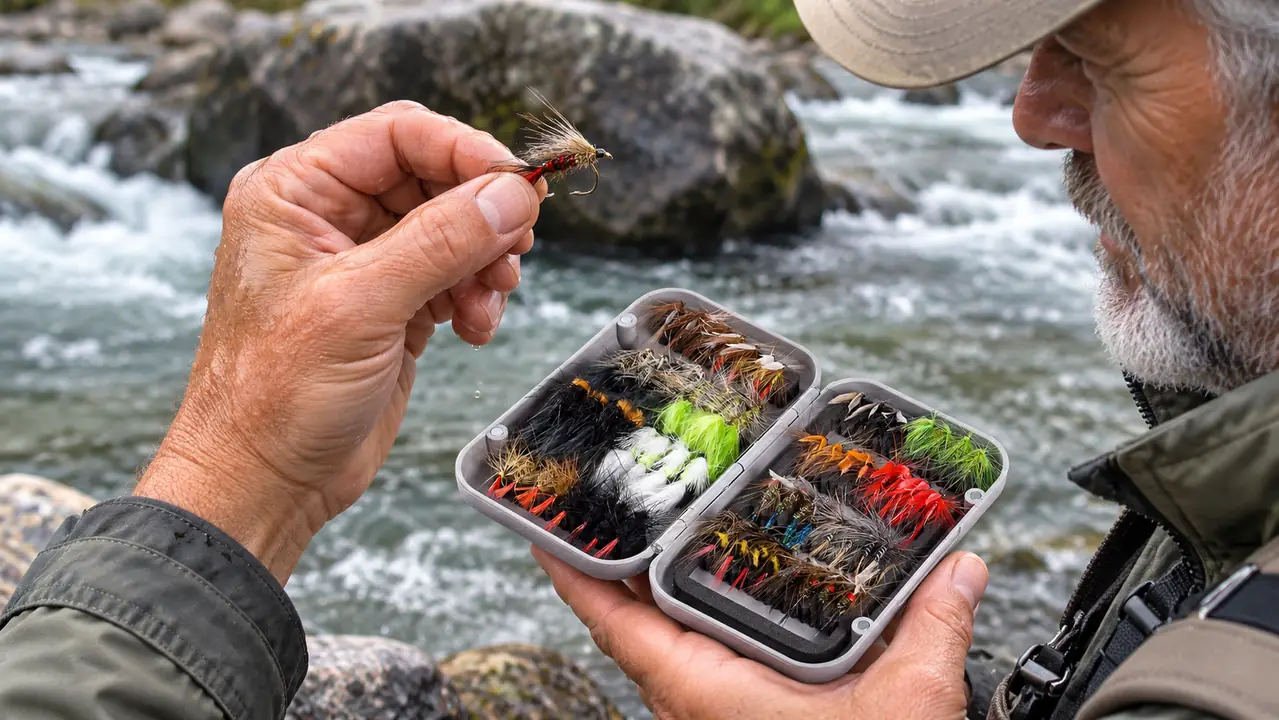
Sixty-four flies across seven groups, according to the listing: mayfly dries, caddis dries, miscellaneous dries, streamers, leeches, wet flies and terrestrials. That is a sensible spread. It covers the surface, the film and the bottom, and it does not dump forty variations of a single pattern on you the way some kits do. The listing photos are the real inventory, so study those before you buy rather than trusting a description of the mix.
The trout dries are the weakest group in terms of range. There are enough to fish a mayfly or a caddis hatch, but not enough to match one precisely, and the difference matters on the Deschutes in late May when the fish have a specific silhouette in mind. What the dries are good for is prospecting, the kind of fishing where you cover water and let the fish tell you what they want. I used them that way and stopped expecting more.
The terrestrials and the leeches are where the kit earns its keep. A leech in still water is close to a sure thing, and the box carries enough of them that losing three to a snag does not end your day. Terrestrials in August along a grassy bank are the same story. Between those two groups I have fished this box hard and never once run out of the pattern I wanted.
How the Flies Hold Up
The hooks are spear point per the listing, and they come sharp. I checked a dozen against my thumbnail straight out of the box and all but two bit. Those two I touched up with a file and they were fine. For a kit at this level that is a better hit rate than I expected, and I have bought shop flies that needed the same attention.
Tying quality is where the honest answer gets mixed. The streamers held together well. I fished one through a full day of casting into willow shade on the Crooked, snagged bottom twice, and it came back looking used rather than destroyed. The dries are more fragile. Two of the small mayfly patterns came apart at the wing after a handful of fish each, and one leech lost its tail to a fish that fought like a wet sock and was probably a squawfish.
Durability on the dries keeps leading me back to the same conclusion. On a warm afternoon in early June on the Deschutes I fished one small caddis pattern through an entire evening rise, maybe fifteen fish, and by dark the feathering was matted flat and the body had worked down the shank. It still floated. It did not float well. I dried it on my shirt, dusted it, and got two more fish out of it before I retired it to the truck box. A shop fly would have done the same thing, honestly. I just would have paid more for the privilege.
None of that is surprising and none of it is disqualifying. Flies are consumables. The question is whether they fail at the hook or before it. These fail before it, in the way inexpensive flies always do: material works loose, thread wraps give up, and eventually you retire the fly to the truck box. What I did not see all season was a hook bending out on a fish or snapping at the bend. For a kit that lives in a vest as a backup, that is the failure mode that actually matters.
The Box Itself and How It Carries
The box measures 3.94 by 2.76 by 1.18 inches, which makes it palm-sized rather than a boat box. It fits in the chest pack I actually carry and it fits a vest pocket, and it does not bulge enough to be irritating when I sit down in the truck. The closure is a magnetic fastener, and that is the detail I expected to fail first. Magnets in fishing gear usually mean a lid that pops open inside a pack and empties your flies into your rain jacket at the worst possible moment.
This one has not done that. It has been in and out of a chest pack for a full season, ridden in the Tacoma's console for a month, and gone into the river twice: once when I slipped on a slick rock on the Deschutes, and once when I set the pack down in the shallows to land a fish. Both times the lid was shut and the flies were still where I put them. I will not call it waterproof, because it is not sold as waterproof and I am not going to claim otherwise. I will call it tight enough, which is the honest version.
The other thing I noticed is how it opens. The magnetic lid is quiet and it comes up with one hand, which matters more than it sounds like it should when you are standing waist deep with a rod pinned under your arm and the wind coming down the canyon. I have fumbled with snap latches in cold weather for years, usually with gloves on, usually while a fish is rising ten feet away. This I can pop open with a thumb, take a fly out, and close again without looking down for more than a second.
The one thing I would change is labeling. Sixty-four flies in a box that small means you are picking through them, and there is no size printed on the flies themselves. If you are the kind of angler who wants to know at a glance whether he is tying on a size 14 or a size 12, you will be squinting. My workaround was to sort the box by group and learn where each group lived, which took about a week of daily use and then stopped being a problem.
Where It Falls Short
This kit is not a hatch box. If you fish one river hard and know its hatches, you already own better flies than these for those hatches, and you should keep fishing them. This is a box for the water you do not know, the trip you did not plan for, and the day the fish want something you did not tie the night before.
The size range is the more practical complaint. The patterns run small, and the target species listed on the product page is panfish, which matches what I see in the box. I would not carry this as a primary box to a warmwater pond and expect much from largemouth. The bass patterns people talk about are not really in here in any serious way, so treat the bass part of the title as marketing rather than a promise.
The labeling complaint has a second half. Because the flies carry no markings, you also cannot reorder a pattern you liked without going back to the listing photos and matching shape and material by eye. I lost a small dark streamer to a rock on the Crooked in October and have not replaced it, because I still cannot tell you what it was called. That is a minor annoyance, but it is the kind that stacks up over a few seasons, and it is the one thing I would pay a little more to have fixed.
Second, sixty-four flies is more than I want in a vest at one time. I pulled about twenty out for the chest pack and left the rest in the truck as resupply, and that is how I would suggest you run it. The full kit is a good thing to own. It is not a good thing to carry all day, and pretending otherwise just means you are hauling weight you will not fish.
What I Liked
- Sixty-four flies across seven groups: mayfly dries, caddis dries, miscellaneous dries, streamers, leeches, wets and terrestrials
- Magnetic lid stayed shut through a full season of pack duty and two dunkings in the river
- Palm-sized at 3.94 by 2.76 by 1.18 inches, so it fits a chest pack or a vest pocket
- Streamers and terrestrials are the strongest groups and held up to hard use
- Sharp spear point hooks, with only two of the twelve I checked needing a touch-up
Where It Falls Short
- No size marking on the flies, so sorting them takes a week of use
- Two small mayfly dries came apart at the wing after a handful of fish each
- Sizes run small, and it is not a serious warmwater bass box despite the title
- Carrying all sixty-four at once is more weight than most anglers need
I fished maybe five patterns out of my old box for eleven years. In one season with the BASSDASH kit I fished nineteen, and three of them have earned a permanent spot in my vest.
Who This Is For
This is for the angler who wants one box that covers most situations without thinking about it. If you fish a handful of different waters a year, if you take a trip somewhere you have never been, if you keep a kit in the truck for the evening when the river looks right and you did not plan on going, this belongs in the rotation. It is also a reasonable first box for someone learning the sport, because it gives you a wide enough spread to figure out what you like without spending a season buying singles at a shop counter.
It is also a good guest box. I have handed it to two people who had never fly fished, watched them pick out something that looked buggy, and watched them catch fish on it. That is worth more than any specification I can write down.
Who Should Skip It
Skip it if you tie your own flies. You will look at the materials and the finish and you will not be impressed, and you would be right, because these are tied to a volume standard rather than a fine one. Skip it if you fish one river and know its hatches cold, because you already have better tools for that job. And skip it if you expect a kit to replace a vest box you have curated for years. It will not, and it should not.
One more honest note for anyone buying on the strength of the word bass in the product title. The listing is clear that the target species is panfish, and the flies in the box match that. If warmwater bass is what you actually fish, buy flies sized for it instead of hoping this kit stretches. Set your expectations against the listing and you will be happy with what arrives.
One Box That Covers the Water You Did Not Plan For
Sixty-four flies across dries, streamers, leeches, wets and terrestrials, in a box with a magnetic closure that has stayed shut through two dunkings. Rated 4.6 by more than 3,300 anglers.
Amazon Check Today's Price on Amazon →