Short answer: start with the BASSDASH assortment, then buy hand-tied flies once you know which three patterns you actually fish. I'm Cal Merritt. I spent thirty years as an aircraft maintenance technician, and I've fished the Deschutes, the Metolius and the Crooked for about twenty-five. I judge tackle the way I used to judge a part on an airframe: does it fit, does it hold tolerance, does it fail gracefully. On those terms, the BASSDASH 64-piece kit is a sensible first purchase and shop-tied flies are the upgrade you make second.
There is a caveat buried in that sentence and the caveat is the word first. Neither of these is the wrong purchase. They answer different questions, and buying them in the wrong order is how a person ends up with a drawer of flies they never tied on and no real idea what the river wanted in the first place. The order matters more than the choice does.
That is not a knock on the tyers. A hand-tied fly from a good shop is a better object than anything in a mass-produced box. Better hooks, better materials, and a person behind the counter who will tie you twenty of the same pattern so they all behave identically. But better at what, and better for whom? If you cannot yet tell a caddis from a mayfly on the water, twenty identical hand-tied dries are an expensive way to find out. The BASSDASH kit answers the question of what the fish want before you spend real money on the answer.
| BASSDASH 64-Piece Assortment | Hand-Tied Flies from a Shop | |
|---|---|---|
| Pattern range | 64 flies across seven categories: mayfly dries, caddis dries, streamers, leeches, wet flies, terrestrials and miscellaneous dries | Whatever your local tyer stocks, which is often deep on one hatch and thin on everything else |
| Day-one readiness | Arrives loaded in a fly box, so you can fish it the same afternoon | You supply the box, and you have to choose the patterns yourself before you leave the shop |
| Hook quality | Spear point hooks that are serviceable but not premium, which is the fair criticism of any kit | Tyers usually build on better hooks that hold a point across more than one season |
| Repeatability of one pattern | You get what is in the kit, and replacing one used-up pattern means buying another full assortment | Order a dozen of one size and one pattern, all identical, whenever you want |
| Exact hatch matching | Close approximations in the sizes shown in the listing photos, good enough to get eats on most water | A tyer can match size, profile and shade to what is coming off that week |
| Storage | Box measures 3.94 by 2.76 by 1.18 inches and closes on a magnetic fastener | No box included, and paper envelopes do not survive a wet vest pocket |
| Learning value | Enough variety to work out what a river wants without committing to one theory | Teaches you nothing about variety, because you bought the same fly twelve times |
| Losing flies | A lost fly is one of sixty-four, and the kit absorbs the loss without a trip to town | A lost hand-tied fly is a decision about whether to drive back to the shop |
| Best for | Learning a new river and building confidence on trout, bass and panfish | Fishing a specific hatch on water you already know cold |
Where BASSDASH Wins
The kit's real advantage is coverage. Sixty-four flies across mayfly dries, caddis dries, streamers, leeches, wet flies and terrestrials means you can walk up to a river you have never seen and still have something plausible to tie on. The morning I keep coming back to was the second week of June on a stretch of the Metolius I had never fished. I parked at a gravel pullout, walked a quarter mile downstream, and had no idea what was hatching. The water was cold, nothing was showing on the surface, and I had two hours before I needed to be back at the truck. So I started with a streamer because it was the least thoughtful option, worked a seam for twenty minutes without a touch, moved to a wet fly, then a leech, then a small mayfly dry when a few naturals finally appeared. The dry got two fish. A shop in town would have sold me one pattern with total confidence and been wrong twice.
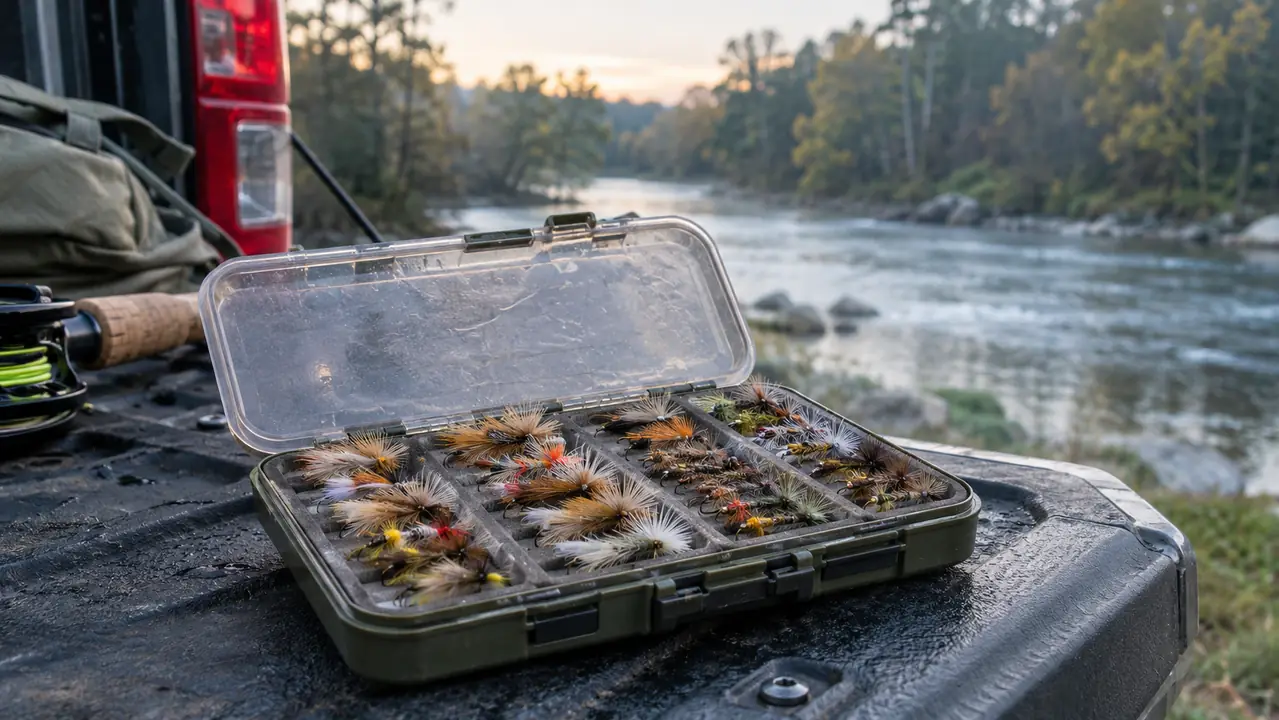
The second advantage is the box, which sounds like a small thing until you have carried flies in a paper envelope. The case measures 3.94 by 2.76 by 1.18 inches and closes on a magnetic fastener. That is roughly the footprint of a wallet, so it drops into a vest pocket or a chest pocket without bulging. The magnet matters more than the size. I can pop the lid with one thumb while the other hand holds a rod, and it stays shut in a pocket without a snap to fight or a zipper to clog with sand. Hand-tied flies from a shop come in an envelope or a baggie and you supply the box, which nobody mentions when they tell you to buy local. I have a small plastic box in the Tacoma that has held shop flies for years, and its latch broke in 2022. I have been meaning to replace it since.
Where Hand-Tied Flies Win
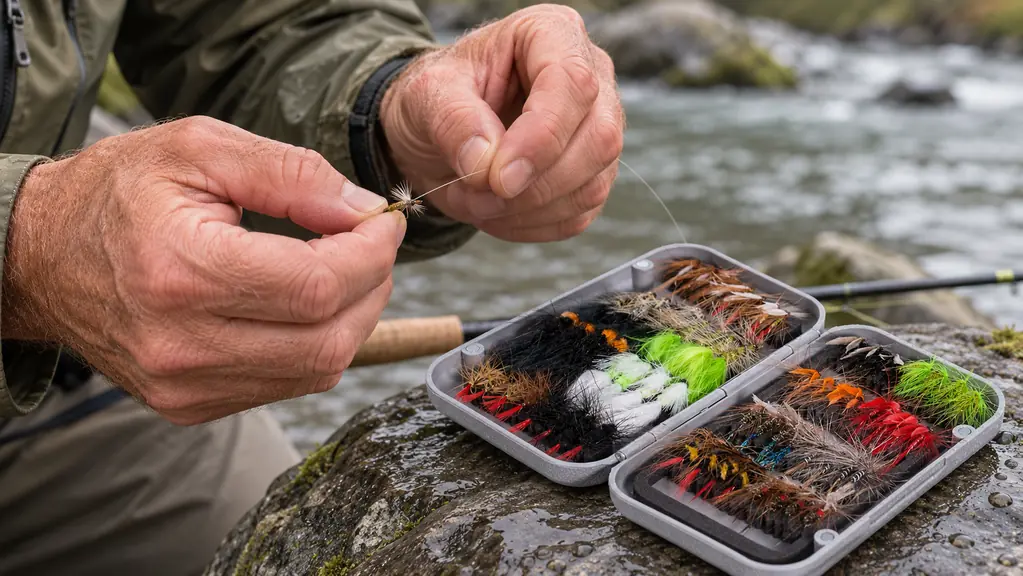
The hooks. Spear point hooks in a mass-produced kit are serviceable, and I have landed plenty of fish on them, but they are not premium hooks. A hand-tied fly from a serious tyer gets built on a hook that holds a point longer, survives more than one snag, and does not straighten on a heavy fish. I had this lesson handed to me on the Crooked in August, on a fish that went maybe sixteen inches and came unpinned at the net after two runs. The point had rolled over on a rock earlier in the morning and I had not checked it. A better hook would have bought me another fish or two before it gave up. That is the whole argument, and it stops being abstract when you drive an hour each way to be there.
The other thing a tyer sells is repeatability. If a size 16 caddis is what the Crooked wants in July, you can walk in and ask for twenty of that exact fly, one size, one shade, all behaving the same. I did exactly that in a shop in Bend after a full season of sorting through the kit, and the difference on the water was immediate: same float, same profile, same hook, so when a fish refused one I knew it was my drift and not the fly. With an assortment you get a handful of each and no way to reorder just the one that worked. The listing photos show the patterns and sizes, and they are worth studying closely, because the mix is fixed and the fly you fall in love with may be the one you only got two of.
A box of 64 flies will not make you a better caster. It will stop you from guessing which fly to tie on, and that is a different problem solved.
Sixty-Four Flies That Cover a River You Have Never Fished
Seven pattern categories, a box that fits a vest pocket, and a magnetic lid you can open with one cold hand. That is the whole case for the assortment, and it is a good case.
Amazon Check Today's Price on Amazon →What's Actually in the Box
Sixty-four flies split across mayfly dries, caddis dries, miscellaneous dries, streamers, leeches, wet flies and terrestrials. I dumped the whole box onto the tailgate the first evening and sorted it into piles by category, partly to see whether the count was honest and partly because I am the sort of person who sorts hardware by size. The count was honest. The spread is a working cross-section of a fly shop rather than a specialized collection, which means you can fish dry, wet or subsurface on the same afternoon without opening a second box. The terrestrials were the surprise. I expected ants and beetles to be an afterthought in a kit like this and they are a real part of it, which matters on the Deschutes in late summer when the fish are looking up under the alders and nothing else is coming off.
The stated target species on the listing includes panfish, and the title names trout and bass. That matches how I have used it: high lakes in the Cascades for small fish that will eat almost anything, and the bigger rivers when I want a streamer or a leech on a sink tip. The sizes lean small, which suits trout and panfish and is less useful if you are chasing largemouth in heavy cover with a big streamer. The streamers are the shortest-lived flies in the kit, partly because they get fished hardest and partly because a soft tail only takes so much abuse before it turns into a stem. Expect to retire a few by midsummer. I keep the chewed ones in a compartment anyway, since a battered streamer still catches fish on a lake where nothing has been educated.
How I'd Fish It Through a Season
Open the box in March and treat it as a survey. Tie on something different every hour. Do not worry about matching the hatch perfectly, because you cannot yet, and the fish will forgive more than the magazines suggest. What you are building is a record of what produced. I keep a small notebook in the Tacoma's console and write down the fly, the water, the time and whether anything happened, which is a habit left over from thirty years of maintenance logs and turns out to apply to fishing just as well. Mine, over one season on the Deschutes, came down to two streamers, one caddis dry and a leech pattern. Everything else was scenery.
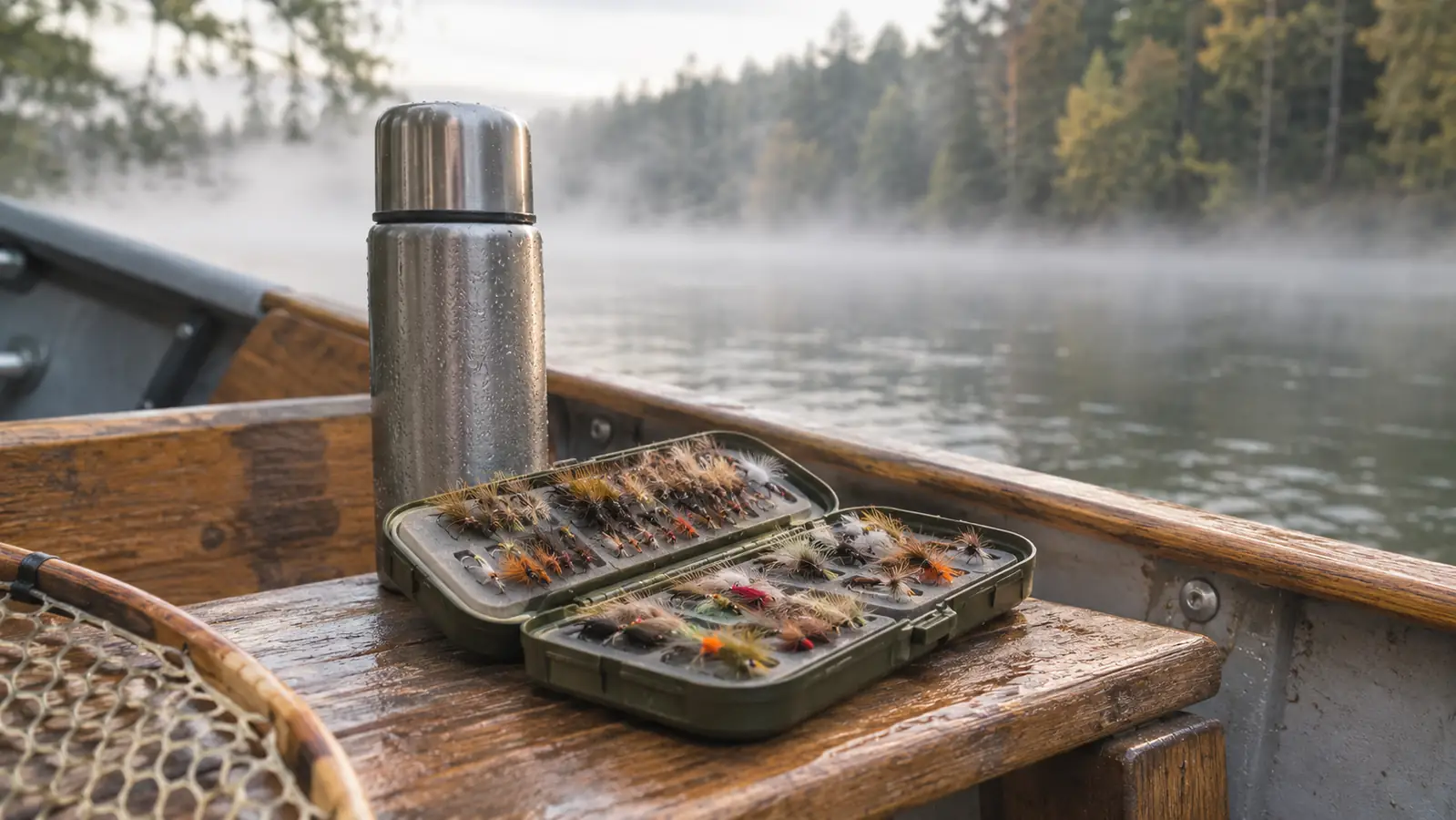
By July you will know your four or five patterns, and that is when the box stops being a survey and starts being a supply problem. That is the point to walk into a shop and buy twenty of each, hand-tied, in the exact sizes you settled on. The money goes where it counts and you are not guessing anymore. The kit has done its job by then, and it stays in the truck as the spare box for a guest or for the odd afternoon when the fish want something strange and you feel like trying something strange back at them. I keep mine behind the seat next to a thermos and a spare spool, and it has rescued more than one trip that started badly.
The failure mode I watch for is treating the assortment as a permanent answer. Flies wear out, hooks dull, and the patterns you burn through are the ones you use most, which means the ones you depend on go bad first. If you never upgrade the three flies you actually fish, you will spend a season tying on the same dull hook and blaming your drift for the result. The BASSDASH box is a starting position, not a finish line, and reading it that way is what keeps it useful. I run a thumbnail down every point every few outings, the way I used to check a fitting for burrs, and I retire anything that drags instead of biting.
Who Should Buy Which
Buy the BASSDASH assortment if you are new to fly fishing, if you are fishing unfamiliar water, if you keep a spare setup in the truck for guests, or if you want a cross-section of patterns to learn from without committing to one tyer's opinion. It also suits the angler who loses flies at a rate that makes hand-tied patterns painful, which on a brushy creek bank is most of us. Joanne comes along on the camping trips and does not fish, but she has watched me lose three flies to the same alder branch in ten minutes, and even she thought the kit was the more sensible purchase of the two.
Buy hand-tied flies if you already know your water and your four patterns, if you are matching a specific hatch, if hook quality is the thing that has been costing you fish, or if you want the same fly twenty times over. The honest answer for most people is both, bought in that order. Assortment first to find out, hand-tied second to execute. The kit is the question. The tyer is the answer to a question you have already asked, and paying for an answer before you have asked it is how a fly box fills up with things you never use.
Start With the Assortment, Upgrade When You Know Your Flies
Sixty-four flies, seven categories, one pocket-sized box with a magnetic lid. Find your four patterns first, then spend the real money on them.
Amazon Check Today's Price on Amazon →