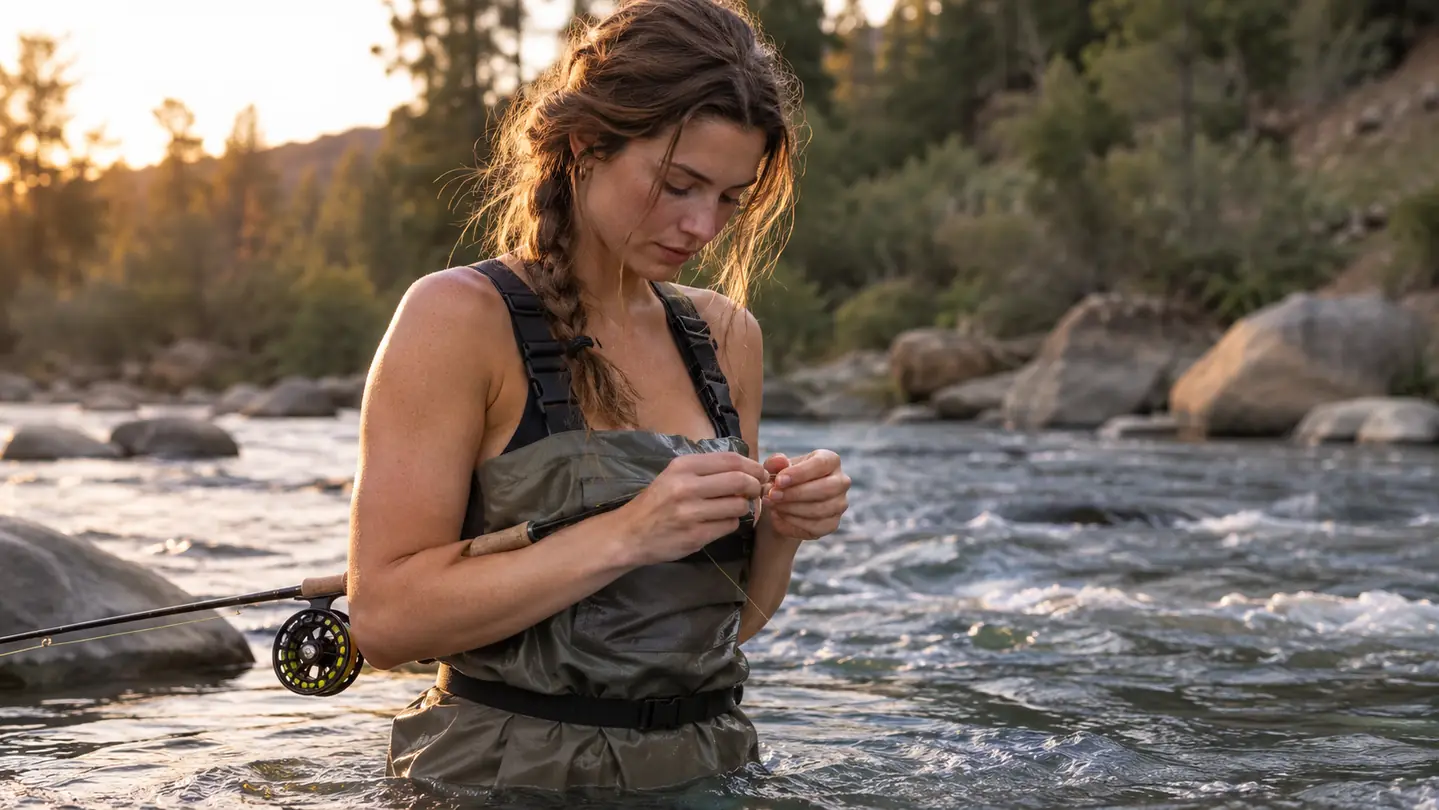
The light is going. There is a seam fifteen feet out with three fish working it, and you are standing waist deep with a tag end clamped in your teeth because both hands are busy and the wind keeps trying to take the spool downstream. By the time the knot seats, the rise is over. That is not a fly selection problem and it is not a drift problem. It is a hand problem. Retired aircraft mechanic talking here: the failure was never the material, it was the interface, and cold wet fingertips are a bad interface for 5X tippet.
I have been tying tippet on the Deschutes, the Metolius and the Crooked for about twenty five years, and for most of that I did it the usual way, fingers and teeth and a certain amount of language my wife Joanne pretends not to hear. What changed it was a small aluminum kit, the Booms Fishing FF3 7 PCS Fly Fishing Tools Kit, which keeps a knot tool, a line clipper and a 7.5 inch stainless hemostat in one place instead of spread across four pockets. Here is how I use it to tie tippet knots faster, step by step, and where it still leaves the hard part to you.
Your Fingers Were Never the Right Tool for 5X
The Booms Fishing FF3 kit puts the knot tool, line clipper and hemostat on a single retractor, so the next re-rig is one reach instead of four. Aluminum body, 4.6 stars from 639 reviews.
Amazon Check Today's Price on Amazon →What a Knot Tool Actually Does, and What It Does Not
A knot tool is a handle. That is the entire idea and it is a good one. Your fingers are the wrong diameter, the wrong temperature and the wrong texture for material measured in thousandths of an inch. The tool is a solid object you can grip with your whole hand while the loop stays open exactly where you put it. It does not tie the knot for you. It does not know whether you wrapped twice or three times. It simply takes the holding away from the part of you that is worst at holding.
That distinction matters, because most knots that fail on the water fail for a reason that has nothing to do with the pattern. They fail because the loop closed early, or the tag crossed, or you pulled the wrong end to seat it. All three of those are grip failures. Hand the grip to a tool and the same knot you already know how to tie comes out right more often, in worse conditions, which is the only place it counts.
The kit also handles the second half of the problem, which is everything that happens after the knot: clipping the tag, stashing the spools, hanging the net. A knot you cannot clip and a net you cannot reach are the same delay wearing a different coat. When the knot tool, the clipper and the hemostat all hang off one retractor, the sequence stops breaking in the middle.
Step 1: Cut a Clean Tag and Get the Spools Where You Can See Them
Start with the spool, not the knot. The tippet holder in the kit carries up to five spools and clips to a pack or vest with a carabiner, which sounds like a small thing until you have spent four minutes digging through a chest pack for the 5X you knew you had. Load it before you leave the truck. Five spools covers the range I actually fish on the Deschutes, from 3X down to 6X, and having them on the outside of the pack means I choose a size by looking instead of by memory.
Pull off more tippet than you think you need, a hand's length at minimum, and cut it with the line clipper rather than your teeth. Teeth crush fluorocarbon and leave a flattened burr that will not seat cleanly in a knot. The clipper gives you a square cut in one squeeze, and it rides the same retractor as everything else, so you are not patting pockets while the current pushes you downstream.
One habit worth building: cut the tag at a slight angle instead of straight across. A point feeds through the loop and through the hook eye with less hunting, and hunting is where the time actually goes. It costs the same single squeeze.
Cold is the other half of it. On a Cascades morning in June the air can be forty degrees and the water is not much better, and fine motor control goes before you notice it going. A tool you grip with your fist does not care about any of that. That is not a comfort feature. It is the difference between finishing the rig and walking back to the truck.
Step 2: Form the Loop With the Tool, Not Your Fingertips
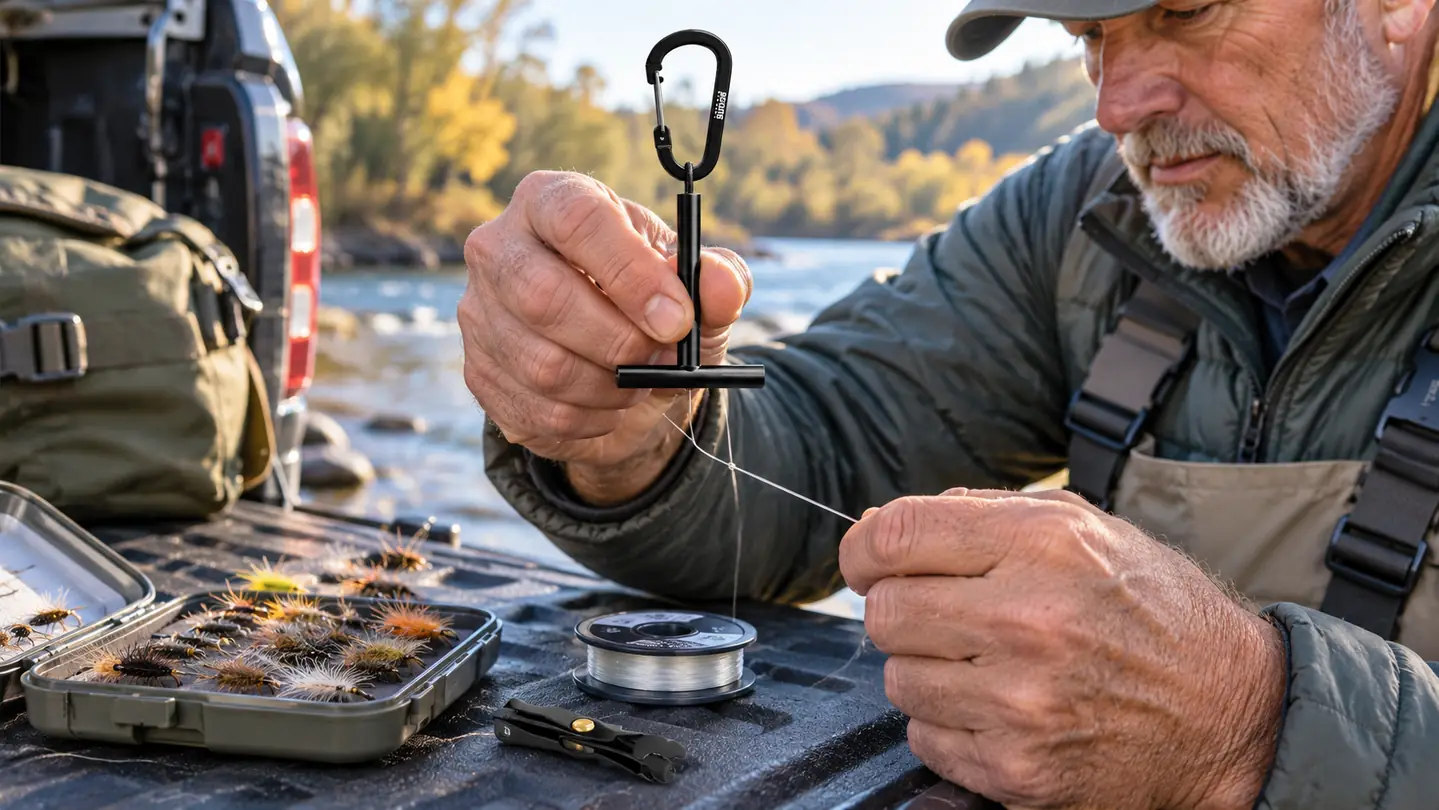
Lay the tippet alongside the leader with about six inches of overlap, then bring the tag end back around to form a loop. This is where fingers fail. Two cold fingertips cannot hold an open loop and manage a tag end at the same time, so the loop collapses and you start over. Take the loop in the knot tool, hold it open, and let your other hand do the one job it is still good at, which is passing the tag through.
For a double surgeon's, pass the tag and the loop through the opening twice, then wet it. Two passes is the workhorse for joining tippet to leader. One pass is weaker, three is bulkier than it needs to be, and neither is worth arguing about on the water. What matters is that both passes go through the same opening in the same direction, which is far easier to confirm when the loop is held open by something rigid instead of by a fingertip you cannot feel anymore.
The 7.5 inch stainless hemostat in the Booms Fishing kit handles the other end of this. If the hook eye is small or the light is bad, clamp the fly by the bend and let the hemostat hold it while both of your hands work the knot. It also mashes a barb flat in one squeeze, which is worth doing before you are standing in a catch and release section trying to remember whether you did.
Step 3: Wet It, Then Seat It With a Steady Pull
Spit is fine. River water is fine. What is not fine is pulling a dry knot tight. Nylon and fluorocarbon both generate heat under friction, and a dry knot seated hard can give away a meaningful share of its strength before it ever touches a fish. Dip the whole thing, then pull.
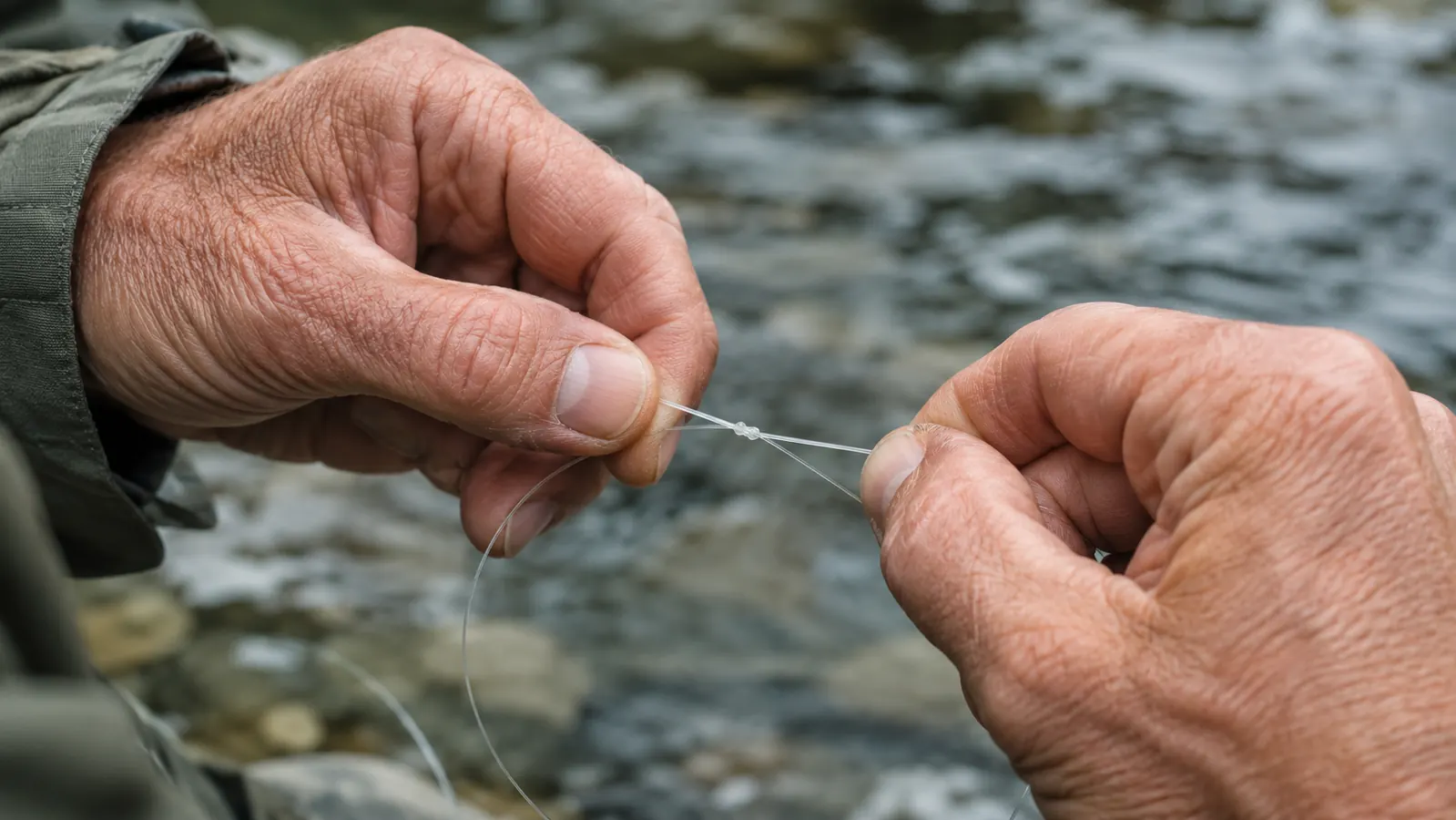
Pull the leader and the tippet apart with a steady, increasing load rather than a jerk. Hold the tag end with the hemostat while you do it, so the wraps cannot back off while the knot seats. You will feel it go from sliding to solid. That transition is the whole event. If it never goes solid, something crossed, and you are better off cutting it away and starting again than hoping.
Check it by looking before you clip. The wraps should sit in an even stack with no gap and no crossover. On a surgeon's knot you want two clean passes lying side by side. If one is riding over the other the knot will still hold, but it will hold unevenly, and uneven knots are the ones that let go on the fish you wanted.
The tool does not tie a better knot than my fingers ever did. It ties the same knot while the wind is trying to take it, which is the only condition that ever mattered.
Step 4: Clip Close and Test It Before You Cast
Clip the tag close, maybe a sixteenth of an inch, using the line clipper. Long tags catch on guides and pick up algae and cost you distance. Short tags that nick the knot body cost you the fish. The sixteenth rule is worth following because it is easy to see in good light and easy to feel with a thumbnail when there is no light at all.
Then test it. A steady pull, maybe a third of what the tippet is rated for, and watch the knot rather than the line. A knot that is going to slip usually slips right there in your hand, which is a far better place to learn about it than fifteen feet out with a fish on.
The retractor matters more at this stage than people expect. Everything hangs off one point, so clipping, testing and re-rigging all happen without setting anything down. Anything you set down in a river is gone. I have donated two clippers and one very good pair of forceps to the Deschutes over the years, and the retractor is the reason that count stopped where it did.
Step 5: Drill It Until the Whole Rig Takes Under a Minute
Speed does not come from the tool. It comes from running the same sequence the same way until you stop thinking about the order. Sit on the tailgate of the Tacoma, or at the kitchen table with Joanne asking why you are tying knots indoors, and tie the same knot ten times in a row. Then tie it ten more with your eyes closed.
The sequence I use is: cut, stage, loop, pass, wet, seat, clip, test. Eight beats, always in that order. Once the order is automatic the tool does what it is good at, which is holding, and your hands do what they are good at, which is nothing complicated.
A note on the net release, since it is the piece of the kit people ask about. The 6.6 lb magnetic release keeps the net on your back where it does not hang up in the willows, and it lets go with a straight pull when you need it. In fast water that is a real difference rather than a convenience. The whole kit packages at about 10.5 by 7.8 inches and a quarter of a kilo, so it lives in the truck box and the vest without ever becoming a decision.
What Else Helps
Two things outside the kit are worth the effort. The first is your leader. A leader with a wind knot or a frayed section will not hold no matter how well you tie the tippet to it, so run the last two feet through your fingers before you re-rig and cut back to clean material if it feels rough. The second is light. A small headlamp with a red setting, carried in the same pocket as the kit, means you can finish a re-rig at last light instead of standing in the dark guessing at a tag end.
One more thing, and it is the least interesting item in this article: carry a spare spool of the size you use most. The moment you are down to the last two feet on a spool is the moment you will need three. The Booms Fishing tippet holder has room for five, and leaving one slot empty on purpose is a decision I have regretted exactly once, which was enough.
And one honest limitation before you buy anything. A knot tool will not teach you which knot to use. It will not tell you that a surgeon's knot is a poor choice when the two line diameters are far apart, and it will not stop you from tying a knot with too few wraps. It is a holding device, and holding devices only amplify whatever technique you brought with you. Learn two knots well, one for joining tippet to leader and one for the fly end, and the tool earns its keep. Bring no technique at all and you have bought a nicer way to fail.
One Reach, One Knot, One Less Reason to Miss the Rise
The Booms Fishing FF3 kit keeps the knot tool, line clipper, hemostat, tippet holder and 6.6 lb magnetic net release together on a single retractor. Aluminum body, 4.6 stars, 639 reviews.
Amazon Check Today's Price on Amazon →